
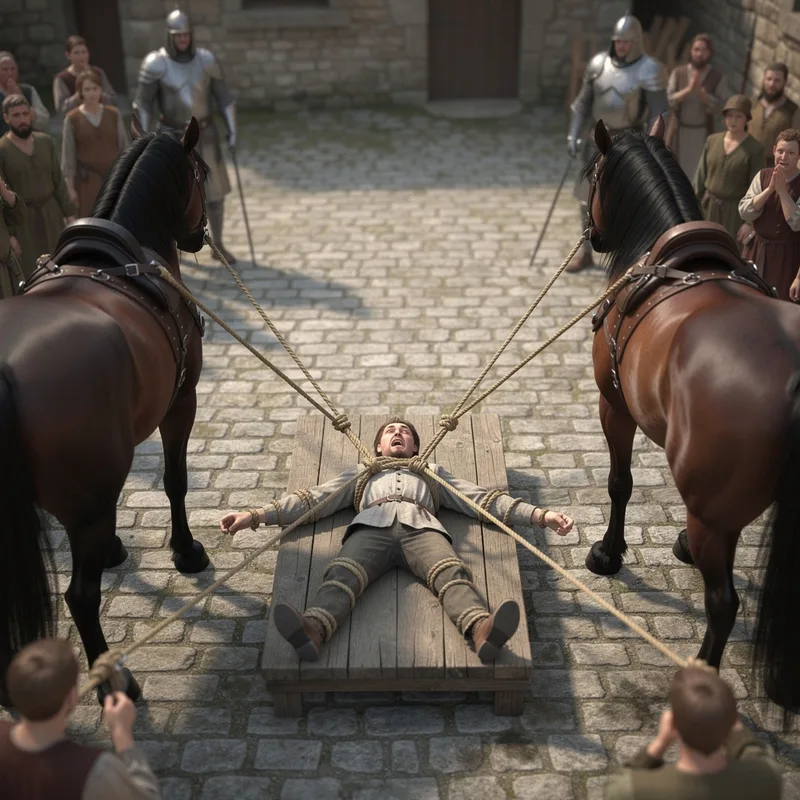
to draw and quarter
 4
9.9
4
9.9

- idiom
- /drɔː ənd ˈkwɔːrtər/
- Offensive
- Brandreth, Ludlam, and Turner were sentenced to be hanged, drawn, and quartered.
- draw and quarter this man
- hang, draw and quarter
Loading YouTube…
Watch on YouTubeThey also the six leaders were drawn and quartered and King Court was gibbeted alive.
- They also the six leaders were drawn and quartered and King Court was gibbeted alive.
Examples
-
Have her drawn and quartered.
-
Lesser folk were hung, drawn and quartered, a less honourable means of execution.
-
I should have you drawn and quartered!
-
Perhaps after that, you can have me drawn and quartered.
Fiction book (2002) -
Traitors are drawn and quartered, and their property taken by the Crown.
Fiction book (1993) -
Unfortunately for them, they were discovered, seized, tortured, and executed—not, as one might assume, by burning, but by the equally grotesque spectacle of being hanged, drawn, and quartered.
Blog text (31) -
In medieval England, traitors were often hangdraw and quartered as a severe punishment.
-
He threatened to draw and quarter anyone who betrayed him in the business deal.
-
The king ordered that the traitors be draw and quartered in front of the castle.
Synonyms
 14
9.9
14
9.9
Pull a person apart by tying their limbs to horses
 6
9.9
6
9.9
To kill someone by tying each limb to a horse and pulling them apart
Antonyms

How Severe
- Offensive
4
9.9

- Formal
294
6.1
- Specialized
321
6.3
821
1.0
- Formal
26
6.9
Surface Forms
Morphology
The phrase is compositionally transparent: a learner who knows 'draw' as 'to pull/drag' and 'quarter' as 'to divide into four' can infer an execution involving pulling apart into quarters. Though archaic and culturally specific, the meaning follows directly from the constituent verbs and is therefore likely comprehensible to a B1 learner familiar with those words.
Etymology
The phrase draw and quarter comes from a cruel medieval execution where prisoners were tied by each arm and leg to different horses and the animals pulled them apart. Because of that violent image, draw means 'to pull' and quarter means 'to cut into four parts', so the phrase is used today to say 'punish someone extremely severely'.