

dragon's head
- noun
- US
- She identified the plant by its distinct leaves and realized it was dragon's head.
Examples
-
Many gardeners love dragon's head for its unique flowers that attract pollinators.
-
The dragon's head plant thrives in sunny areas.
-
Gardeners recommend dragon's head for its hardy nature and attractive violet flowers.
-
The garden's centerpiece was a stunning patch of dragon's head in full bloom.
-
Many gardeners love the dragon's head for its unique flowers.
-
Gardeners recommend dragon's head for its hardy nature and attractive violet flowers.
-
The garden's centerpiece was a stunning patch of dragon's head in full bloom.
Synonyms
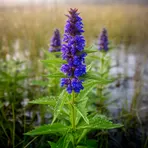
A North American mint herb with long pointed toothed leaves and spikes of blue or purple flowers

A small herb with pointed saw-edged leaves and spikes of blue or violet flowers

A group of small American plants with scented leaves called dragonheads
Surface Forms
Morphology
dragon's + head
Although the parts 'dragon' and 'head' are semantically transparent individually, their combination is a lexicalized plant name (Dracocephalum) whose botanical meaning is not predictable from an animal + body-part reading. A B1 learner who knows 'dragon' and 'head' would not reliably infer that this refers to a specific herb, so the expression functions idiomatically and is opaque.
Etymology
Dragon's head comes from the shape of its flowers: the top of each flower looks like a small dragon head with a curved 'mouth'. So people used that picture to name the herb, and today the phrase means the plant with those blue-violet flowers.

