
downbeat
 1
6.8
1
6.8

- noun
- /ˈdaʊnˌbiːt/
- Specialized
- Older violin students can sway to the phrase or meter, gently bounce their scroll, or bend their knees on downbeats as a way of internalizing the music's pulse.
Loading YouTube…
Watch on YouTubeSo you're constantly saying, OK, rise in this measure, but but start to fall ahead of the downbeat because I don't want a point to the downbeat.
- So you're constantly saying, OK, rise in this measure, but but start to fall ahead of the downbeat because I don't want a point to the downbeat.
Examples
-
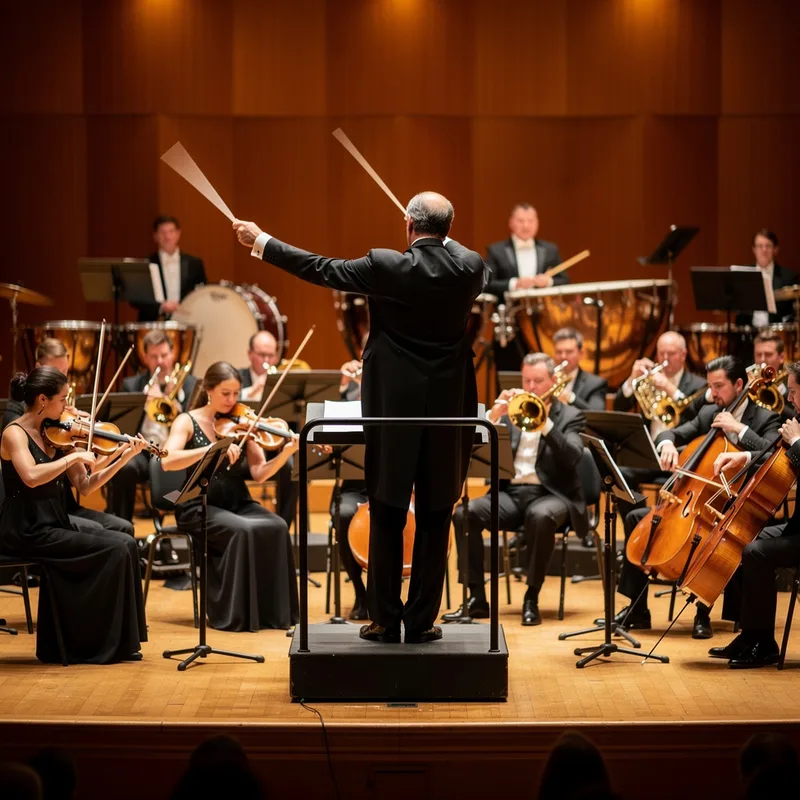
The conductor raised his hand, signaling the musicians to prepare for the downbeat of the next measure.
-
The play/sing-along ends on the downbeat of the chorus followed by the lyrics, "All you need is love."
Academic text (2012) -
My downbeat marks a pause.
-
Downbeats are on one and three.
-
Distinctive downbeats and beat points help make these patterns clear and precise.
Academic text (2012) -
Low-register instruments enter on the downbeat of the middle-register instruments' pattern.
Academic text (2000) -
The dancer steps down on the ball of the foot on the downbeat, then lifts the foot slightly and places it flat on the ground on the upbeat.
Academic text (2003) -
She had turned to stare at him just as the cymbals crashed, the downbeat that began the overture.
Fiction book (1996) -
A slightly more difficult canon is the semi-interrupted canon, where the downbeat of every other measure is played, allowing for continuous music but still making the canon fairly accessible.
Academic text (2012) -
Mr. Aubelchan's baton falls on the first downbeat, and they’re off.
Academic text (2006)
Surface Forms
Morphology
Etymology
Downbeat is made of down ('down' as a direction) and beat ('a strong musical strike', like a drum or a heartbeat), and it originally names the first beat of a measure because a conductor usually moves their hand down to show that beat. So, picture a hand moving down to the first beat to remember the meaning.