
doge
 3
9.9
3
9.9

- noun
- /ˈdoʊdʒ/
- Formal
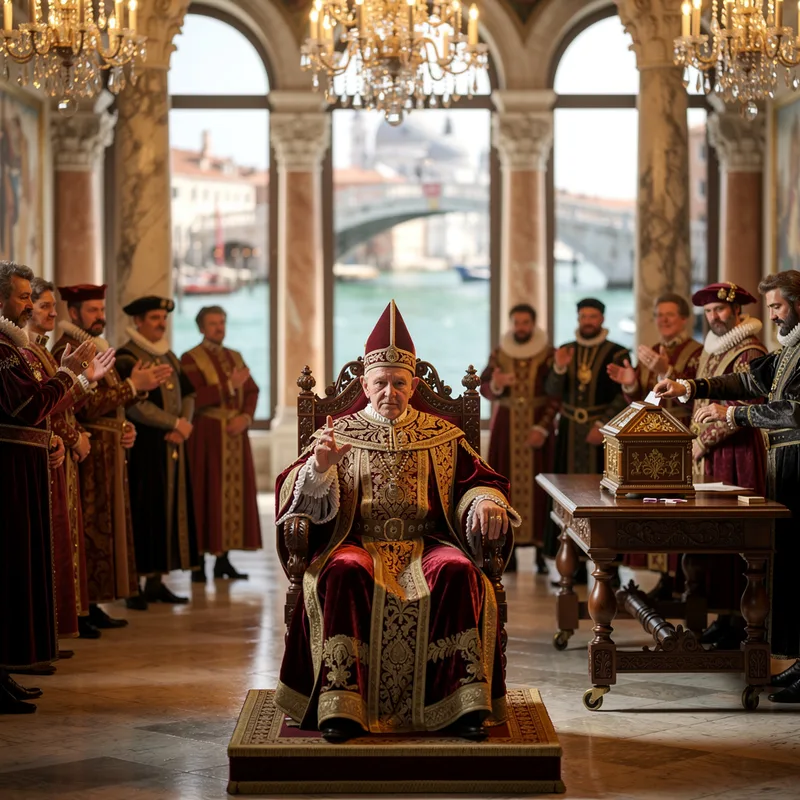
- Historically, the Doge was elected by the aristocracy to lead the city-state of Venice.
- the Doge's Palace
Loading YouTube…
Watch on YouTubeSo now we know that the courts are calling the action of Doge illegal.
- So now we know that the courts are calling the action of Doge illegal.
Examples
-
Maffei was close to Marco Foscarini, who served as official historiographer of the Venetian Republic from 1735 and as doge from 1762 to 1763.
Academic text (2005) -
There was nothing the Doge and Great Council could do but accept his terms.
-
As in the Doge of Venice.
Fiction book (1999) -
Genoa's first doge, a man who has achieved great power but is ultimately poisoned by his political enemies.
Blog text (22) -
With the recent addition of the Duchy of Athens, the Doge had become one of the major players in Greek mainland politics.
Blog text (32) -
The year before Petrarch goes to Rome, the Doge's palace starts to be built.
-
At the Doge's Palace, for example, the Bellini were deliberately played off against their main rivals, the Vivarini.
Academic text (2000) -
Wasn't the Piazza wonderful, and the gondolas and the Doge's Palace?
Fiction book (1994) -
The Feast of the Ascension gave you the best spectacle of all here, with the gilded galley of the Doge emerging once a year for the marriage of the sea.
-
Canal further mentions that on the arrival of the fish sellers in the Palazzo Ducale, Doge Tiepolo made a deal with them on the spot to purchase "many lovely sturgeons and trout and other large fishes."
Academic text (2008)
Synonyms

A high official chosen from outside to lead and judge in Italian cities in the Middle Ages
Surface Forms
Etymology
Doge was the title for the chief ruler of Venice and Genoa and comes from the Latin word dux meaning 'leader'; it is the same root as the English word duke, so a doge was a high-ranking person who led the state.