
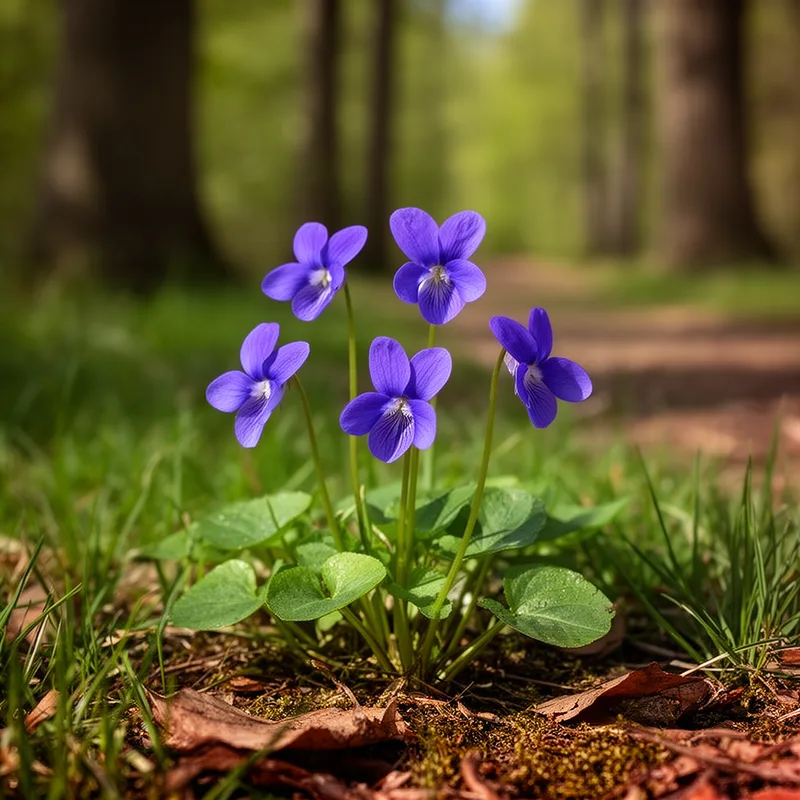
dog violet
- noun
- UK
- We found a patch of dog violet blooming along the woodland path.
Examples
-
Unlike sweet violets, dog violet does not have a strong fragrance.
-
The dog violet blooms beautifully in the spring.
-
The dog violet is easily distinguished by its blue petals and lack of scent.
-
Look at that dog violet!
-
The dog violet blooms beautifully in the spring, adding a splash of color to the forest floor.
-
We found a patch of dog violet blooming along the woodland path, surrounded by lush greenery.
-
Unlike sweet violets, the dog violet is easily recognized by its blue petals and absence of fragrance.
Synonyms

 23
1.0
23
1.0

A small flower with leaves shaped like hearts and purple petals
A small purple wild violet that grows in European woods

A small wild violet from Europe and Asia with thin leafy stems and blue or lilac flowers
A small plant with blue flowers that grows on open wild land
Surface Forms
Morphology
dog + violet
The noun 'violet' clearly signals a plant, so a B1 learner will likely infer this is a type or variety of violet; however the modifier 'dog' does not contribute its literal animal meaning and historically marks a wild/inferior variety, which is not transparently predictable. Because part of the meaning (that it is a kind of violet) is clear but the specific sense contributed by 'dog' is non-literal and requires lexical/phraseological knowledge, the expression is only partially transparent to learners.
Etymology
Dog violet comes from an old use of dog to mean 'ordinary' or 'less valued', not the animal, so people used it to mark the wild, unscented violet found in woods and fields. That's why dog violet today means 'a wild violet without a strong smell', not the sweet garden violet.