
docosahexaenoic acid


 1
7.7
- noun
- /ˌdoʊkəˌsɑːhɛkˈseɪnoʊɪk ˈæsɪd/
- Specialized
- You can ignore the requirement of our brain for certain key minerals and fats such as iron, iodine, copper, zinc, and selenium, arachidonic acid, and docosahexaenoic acid.
- docosahexaenoic acid (DHA)
- eicosapentaenoic and docosahexaenoic acid
Examples
-
ISSFAL looked at the research, and n-3 alpha-linolenic acid does not readily convert into n-3 docosahexaenoic acid in humans.
Blog text (28) -
Many nutritionists recommend increasing your intake of docosahexaenoic acid by eating oily fish regularly.
-
In the freshwater fish, docosahexaenoic acid content ranged from 8.6% to 19.1%, eicosapentaenoic acid from 1.8% to 4.2%, and arachidonic acid from 5.8% to 8.0%.
Academic text (2000) -
The n-3 to n-6 ratio was nearly four times higher in fish-eating than in vegetarian participants, and the ratios of eicosapentaenoic acid and docosahexaenoic acid to arachidonic acid were also higher.
Academic text (2000) -
Consuming docosahexaenoic acid during pregnancy supports the development of the baby's brain and eyes.
-
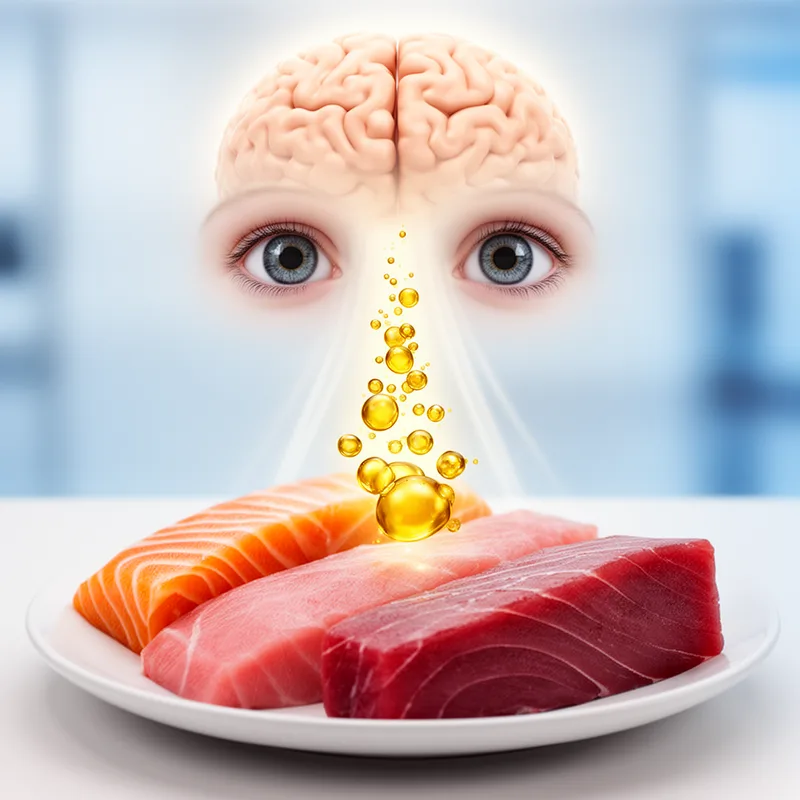
Docosahexaenoic acid is crucial for brain health and can be found in fatty fish like tuna.
Surface Forms
Morphology
This is a compositional chemical name: the adjective specifies a particular type (docosahexaenoic, here an omega‑3 descriptor) and 'acid' identifies it as a chemical substance. If a learner knows the constituent meanings, the combined meaning ('a specific omega‑3 fatty acid') is directly derivable, despite the term being technical.
Etymology
Docosahexaenoic acid gets its name from its parts: docosa means '22', hexa means 'six', and acid shows it is a fatty acid. So the name is a simple code saying this fat has '22' carbon atoms and 'six' double bonds, and that is why scientists call it 'DHA' and use it for brain and eye health.