

division Lichenes
- noun
- /dɪˈvɪʒən ˈlaɪkəniz/
- Archaic
- The division Lichenes once grouped all lichen-forming organisms together, regardless of their fungal partners.
Examples
-
Historical texts often refer to the division Lichenes as a major group alongside fungi and algae.
-
In biology, division Lichenes is often studied for its unique symbiotic relationships.
-
Botanists no longer classify lichens under the division Lichenes in modern taxonomy.
-
The division Lichenes includes various species of lichens.
-
Botanists no longer classify lichens under the division Lichenes in modern taxonomy.
-
Historical texts often refer to the division Lichenes as a major group alongside fungi and algae.
-
The division Lichenes once grouped all lichen-forming organisms together, regardless of their fungal partners.
Synonyms
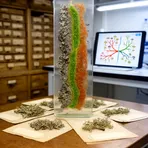
An old scientific group name for lichens that live with algae
Surface Forms
Morphology
The phrase combines the taxonomic rank 'division' with the taxon name 'Lichenes', so its meaning ('the division called Lichenes comprising lichens') follows directly from the constituents. Taxonomic naming is a transparent compositional pattern across languages and contains no idiomatic shift, so a learner who knows both words would infer the MWE's meaning.
Etymology
Division Lichenes comes from old Latin used by scientists: division means a large group and Lichenes was the Latin name for lichens. Lichens are small growths on rocks and trees made when a fungus and an algae live together, so the name was used for 'a group of lichens' in older classifications.

