

dithyramb


 1
9.9
1
9.9
- noun
- /ˈdɪθɪræm/
- Archaic
- Similarly, Eliot writes, "Arion, whose melodic soul / Taught the dithyramb to roll," "carried his diviner lore / From Corinth to the sister shore" (ll. 1-2, 5-6).
Examples
-
The dithyramb is a genre of Greek choral lyric or melic poetry performed in honor of Dionysus.
Academic text (2016) -
During the ceremony, the chorus sang a lively dithyramb that honored the spirit of celebration.
-
Today, most scholars assume that these events occurred in geographical order, as they were related by Bacchylides (Dithyramb 18) in the late sixth century B.C.E.
Academic text (1999) -
On one hand, the poet is a confidence man: in his epics and songs of praise, his odes and dithyrambs, he pretends to have specialized knowledge he cannot possibly have.
Academic text (2007) -
"But Arion no longer needs his physical body; he leaves his art to the world—to the wolfish sailors, to those whom he taught the dithyramb in Corinth, and to those who will use his art form generations after his death.
Academic text (2016) -
Herodotus writes, "Arion was a lyre-player second to none in that age; he was the first man, as we know, to compose and name the dithyramb, which he afterwards taught at Corinth" (1:23).
Academic text (2016) -
In ancient Greece, a dithyramb was often performed to celebrate the god Dionysus during festivals.
-
The poet composed a dithyramb that expressed his deep admiration for the beauty of nature.
Synonyms

A poem that people sing, like ancient Greek songs
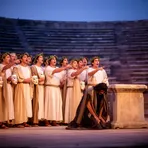
A song sung by the chorus in Greek plays to comment on the action
Surface Forms
Etymology
Dithyramb comes from the ancient Greek dithyrambos, which was a loud 'hymn' sung to honor the god Dionysus and often made up on the spot. Because it was wild and full of praise and rhythm, the word now names that passionate kind of ancient song.