

dissent
 17
8.2
17
8.2

- noun
- /dɪˈsɛnt/
- Formal
- Justice Thurgood Marshall wrote the dissent, with Justice William Brennan joining.
- dissenting justices
- J., dissenting
- Rehnquist, J., dissenting
Loading YouTube…
Watch on YouTubeWell, the Swain case, well, let me mention the dissent.
- Well, the Swain case, well, let me mention the dissent.
- Justice Scalia responds in a dissent.
- Well, they are aware of the, the decision and they have copy of the opinion and of your dissent.
- He wouldn't have granted the cart, and he had a very interesting dissent.
Examples
-
The rule announced by the Nedlloyd majority was criticized by Justice Kennard in his dissent in that case.
Academic text (2017) -
In his dissent in Branzburg, Justice Stewart said, "as the years pass, "the power of government becomes more and more pervasive."
-
The critics of the Declaration published in the volume express dissent at a variety of levels.
Academic text (1999) -
In his dissent in King, Justice Scalia presented this solution quite clearly:
Academic text (2017) -
A full written opinion, with a dissent from Mr. Evans, will be issued to the AEC in the coming days.
-
The dissent argued that the banned procedure is in many cases the safest for the woman.
Academic text (2017) -
But as Justice Blackmun stated in his dissent in South Carolina v. Catawba Indian Tribe:
Academic text (1995) -
Neither the majority nor Justice Thomas's dissent questioned the core holding in Caballes that a drug-sniffing dog.
Academic text (2017) -
A four-judge dissent went further, explicitly rejecting a "bright-line rule." 119
Academic text (2017) -
The judge's dissent highlighted the potential flaws in the majority's ruling.
Synonyms
 7
7.7
7
7.7
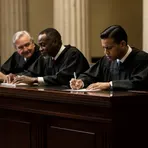
A written statement by one or more judges who disagree with the court's decision
Antonyms

How Dissenting

Surface Forms
Etymology
Dissent comes from the Latin parts dis- 'not' and sentire 'to feel', so it literally means 'not feeling the same'. That is why a judge's dissent is a written opinion explaining why they disagree with the court's majority decision.