
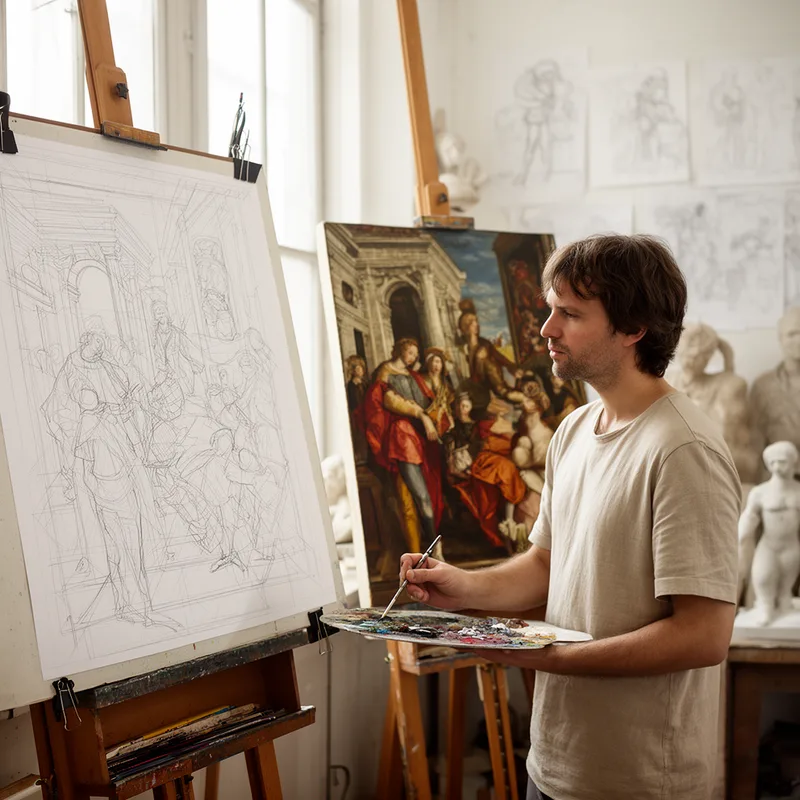
disegno
- noun
- /dɪˈzeɪɡnoʊ/
- Specialized
 :
disegno
:
disegno
- Disegno is manifest both physically, in drawing, and mentally, in design.
- Accademia del disegno
Examples
-
Disegno never dimmed and never grew old.
Academic text (2011) -
Vasari had grouped all the arts under disegno in the 1550 edition and praised Florentine artists for their disegno.
Academic text (1991) -
Disegno served as the agent of historical development but is not history itself.
Academic text (2011) -
Sixteenth-century writers often used Michelangelo as the ultimate demonstration and model of disegno.
Academic text (2011) -
Earlier theorists of disegno understood the term differently, more as a model structuring the history of art than as one attempting to explain the relation between hand and mind.
Academic text (2011) -
Born from that one historical moment when Philocles traced the shadow of man, and reborn ad infinitum into the future of art making, disegno was not itself subject to historical time.
Academic text (2011) -
Parmigianino is one such artist, whose Lombard naturalism is reinforced by Florentine disegno, which he learned from the works of Michelangelo and Raphael.
Academic text (1991) -
Cultural control culminated in the family's support of the Accademia del Disegno, established in 1561 as the first professional stronghold of its sort in Western art history, which institutionalized the making of art as a political program.
Academic text (2011) -
Sixteenth-century thought conveys a consistent attempt to attribute a broad social value to disegno, and not just in the writings of art theoreticians at pains to show that the emancipation of art was also a path to social engagement.
Academic text (2011) -
In Renaissance art, disegno is regarded as the fundamental principle guiding the creation of visually compelling works.
Surface Forms
Etymology
Disegno was also a key idea in Renaissance art, meaning the drawing and the creative idea that guide a work. It is like English design, and because it was about planning and control, disegno explains why artists saw drawing as the base of their art.

