

discriminative
- adjective
- /dɪsˈkrɪmɪnətɪv/
- Specialized
- By applying these methods to original visual features, we can obtain visual features that have more discriminative power.
- discriminative features
- discriminative ability
- discriminative power
Examples
-
The overall discriminative ability of the model was determined by calculating the area under the curve (AUC).
Academic text (2005) -
Based on the AUC approach, the discriminative ability of the SWAAT was determined to be 0.75, which indicates that the SWAAT can accurately distinguish between patients who need services and those who do not.
Academic text (2005) -
We show that the combined features increase the discriminative strength between the target and its surrounding background.
Academic text (2018) -
Based on ROC curves, a score of three or above was identified as having optimal discriminative ability.
Academic text (2005) -
The RQLQ is a reliable, validated instrument with strong discriminative properties.
Academic text (2005) -
The model uses a discriminative approach to accurately classify images based on their features.
-
In our research, we found that the discriminative method was more effective than generative techniques in predicting outcomes.
-
This algorithm has high discriminative power, allowing it to differentiate between various classes in the dataset.
Synonyms

 1
6.8
1
6.8

Able to notice small differences between similar things


 1
8.1
1
8.1
Describing a way to put things into groups by what they have in common
Compounds
- Specialized
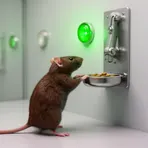
A sign that tells a person or animal when an action will bring a reward
Surface Forms
Morphology
discriminative = discriminate (semi-transparent) = discriminate + ive
Morphologically regular ('discriminate' + '-ive'), but the technical ML sense ('discriminative model') is a domain-specific extension that may not be obvious to general learners.
Etymology
Discriminative comes from the Latin root discrimen, 'separation', and is like discern, 'to see or tell apart'. In machine learning, discriminative describes methods that learn to tell categories apart directly, so they focus on the clear differences needed to pick the right category.