
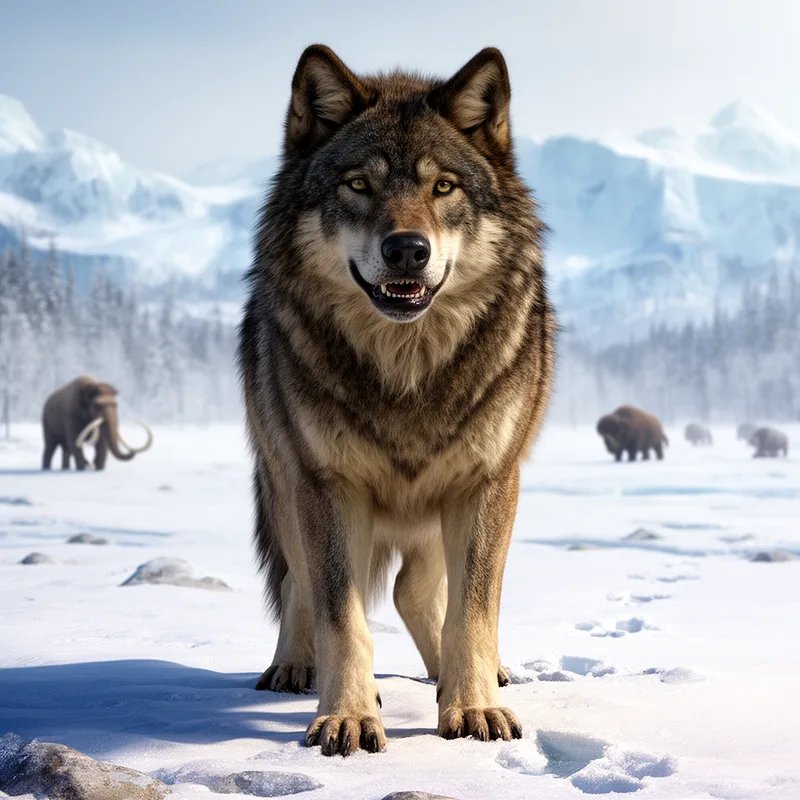
dire wolf


 1
8.8
1
8.8
- noun
- /ˈdaɪər wʊlf/
- US
- Scientists discovered a dire wolf skeleton in the fossil beds of La Brea, showcasing its massive size.
Examples
-
Rather, the large population of predators such as dire wolves and sabertooth cats caused carnivores to compete intensely for food, as evidenced by heavy tooth wear.
Blog text (6) -
The large herbivores seemed to be growing quickly, and just as quickly had their numbers reduced by a range of significant carnivorous predators, including lions, dire wolves, and two species of sabertooth cats.
Blog text (6) -
Caleb, why don't you check out the dire wolf?
-
The dire wolf lived alongside other large predators in North America during the Pleistocene era.
-
Evidence suggests that the dire wolf roamed vast territories, hunting large prey across ancient landscapes.
Surface Forms
Morphology
The phrase is a straightforward adjective + noun composition: 'dire' (very serious/dreadful) modifies 'wolf' (the animal), so a B1 learner who knows both words can infer a very dangerous or fearsome wolf, as used in fantasy. This compositional pattern is common cross‑linguistically and requires no idiomatic knowledge, making the meaning predictable from the parts.
Etymology
Dire wolf comes from when early scientists found huge Ice Age wolf bones and used the word dire (an old word meaning 'frightening') with wolf to show how large and dangerous the animal looked, so the name now refers to that extinct species.