
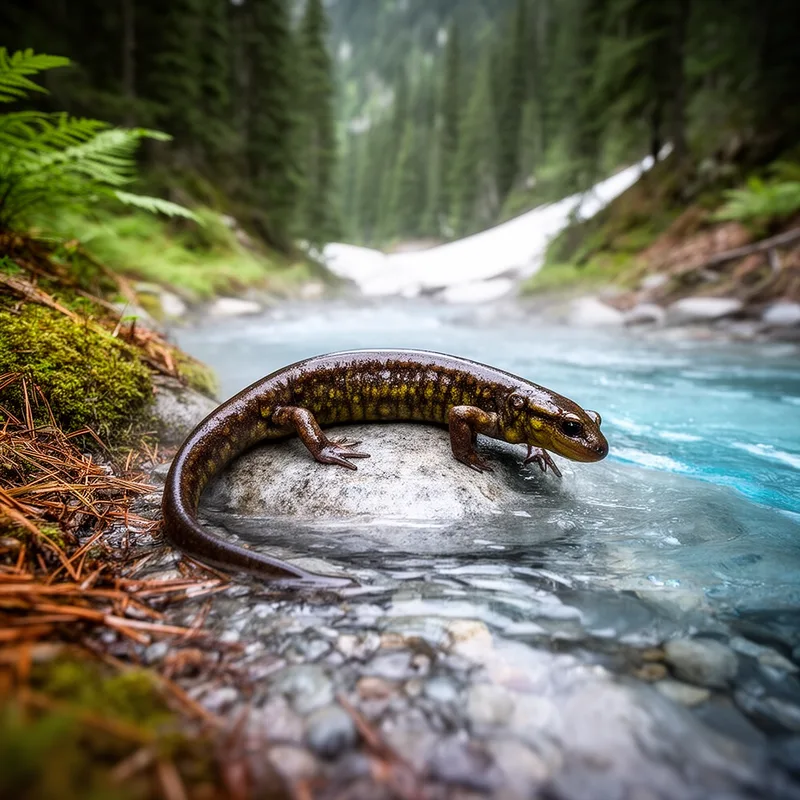
dicamptodontid
- noun
- /ˌdaɪkæmptoʊˈdɒntɪd/
- Specialized
- Many dicamptodontids thrive in North America's cold streams year-round.
Examples
-
Unlike other salamanders, a dicamptodontid can often be found during cooler months.
-
The giant dicamptodontid is native to the forests of the Pacific Northwest.
-
Researchers discovered several dicamptodontids living in a secluded mountain stream.
-
The dicamptodontid is often found in cold streams.
-
Many dicamptodontids thrive in North America's streams.
-
Researchers discovered several dicamptodontids living in a secluded mountain stream.
-
The giant dicamptodontid is native to the forests of the Pacific Northwest.
Synonyms
 16
4.9

A small animal like a lizard with a long tail that lives on land and returns to water to breed
A large salamander that lives near cold streams in western North America
A large salamander up to 7 inches long found in moist forests and streams in western North America

A large salamander that lives in western North American forests
Surface Forms
Morphology
dicamptodontid = Dicamptodontidae (opaque) = dicamptodont + id
The term is a specialized taxonomic formation derived from Latinized family/genus names and suffixes unfamiliar to general learners, so its meaning is not derivable from everyday English morphemes.
Etymology
Dicamptodontid comes from Greek parts di- 'two', campto- 'bent', and odont- 'tooth', so the name literally means 'two-bent tooth', and the ending -id shows it is a member of that animal family, as in canid 'dog family' or felid 'cat family'. That's why dicamptodontid refers to a particular family of salamander — a member of that group often found near cold streams.