
dew point
 2
4.3
2
4.3

- noun
- /djuː pɔɪnt/
- Specialized
- Meteorologists often refer to the dew point to determine how humid the air feels outside.
- dew point temperature
- dew point and humidity
Examples
-
When the flue gas is cooled to a temperature below the dew point, water vapor starts to condense.
Academic text (1997) -
If you cool the air down to the dew point, then water vapor will begin to condense.
-
So I plug the dew point into this model to get the actual water vapor pressure.
-
If you cool the air down to the dew point, then water vapor will begin to condense.
-
This is one of them, an hour-by-hour forecast of cloud cover, temperature, dew point, wind direction and speed, and a probability of precipitation.
Blog text (32) -
Parameters extracted included precipitation, temperature, dew point, and relative humidity.
Academic text (2014) -
If the temperature at the crest of the wave drops to the dew point, moisture in the air may condense to form lenticular clouds.
Blog text (6) -
Hourly ambient and dew point temperature data for each county were obtained from the National Atmospheric and Oceanic Administration's (NOAA) National Climatic Data Center.
Academic text (2014) -
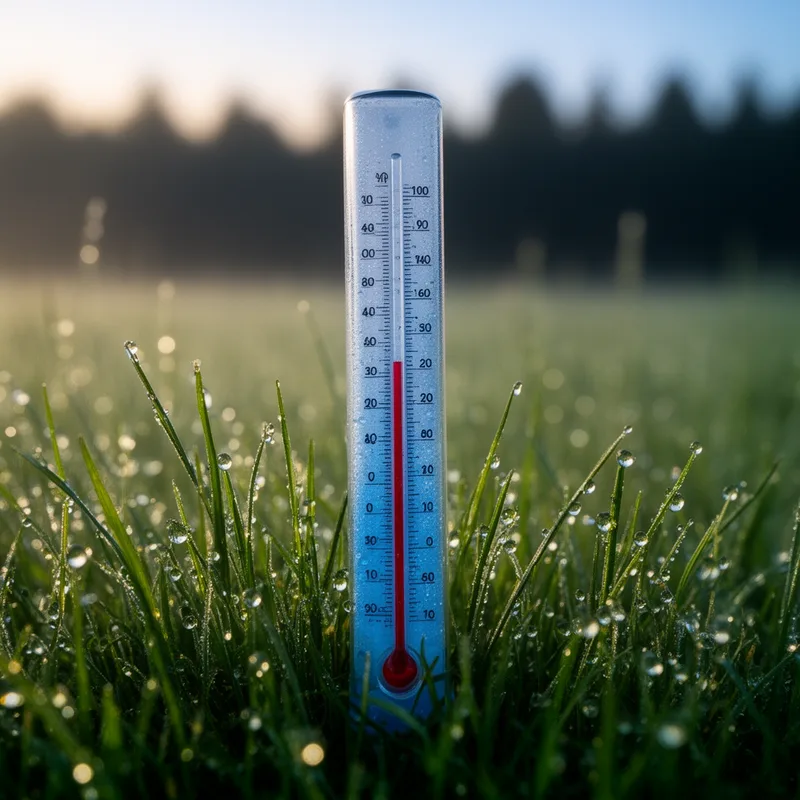
When the temperature falls to the dew point, dew forms on the grass in the morning.
Surface Forms
Morphology
The meaning is directly compositional: 'dew' (condensed water) combined with 'point' (a specific stage/threshold) yields the 'point at which dew forms' — i.e., the temperature when air becomes saturated. This noun-noun construction and the idea of a threshold are cross-linguistically common, so a B1 learner who knows both words should be able to infer the meaning.
Etymology
The noun dew point comes from the simple image of dew, tiny drops of water, forming at a specific point when the air cools, like grass covered with morning dew. So dew point tells the 'temperature' at which dew will form and helps show how wet or muggy the air feels.