
deuteron


 1
9.9
- noun
- /ˈdjuːtəˌrɒn/
- Specialized
- That's that deuteron, the deuterium nucleus.
- deuteron and proton
- deuteron and neutron
- deuteron collisions
Examples
-
The deuterium nucleus, called the deuteron, is a boson with spin 1 and isospin 0.
Academic text (2012) -
With Peierls, he laid the foundations for understanding the structure of the deuteron, neutron-proton and proton-proton scattering, and the photodisintegration of the deuteron.
Academic text (2005) -
What's a deuteron made up of?
-
OK, Now the mechanism is that the deuterium D plus the deuteron adds to the ring.
-
That's where the deuteron, the heavy hydrogen nucleus, comes to the rescue.
Academic text (2001) -
His contributions included several papers with his friend Rudolf Peierls on neutron-proton scattering and on the deuteron.
Academic text (2005) -
And very simply, when positively charged deuterons are attracted to the palladium cathode, they cram together.
-
In 1934, Rutherford and Mark Oliphant bombarded deuterons with neutrons and thus created tritium, the third hydrogen isotope.
Academic text (2012) -
Although Cornell's cyclotron only produced 1.2-MeV deuterons, Livingston and his associates developed an arc source that transformed the cyclotron into a particularly useful tool for neutron research.
Academic text (2005) -
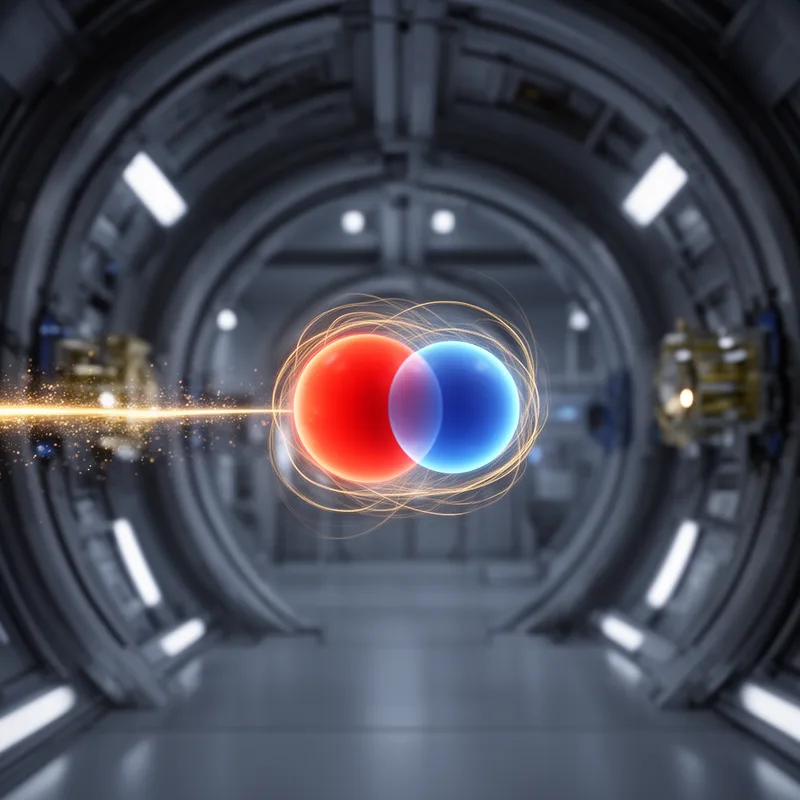
The deuteron consists of one proton and one neutron, making it a key component in nuclear physics.
Surface Forms
Morphology
deuteron = deuterium (semi-transparent) = deuter + on
The relation between 'deuterium' and 'deuteron' is regular (particle name formed with '-on'), but knowing this requires scientific knowledge of particle-naming conventions.
Etymology
Deuteron comes from the Greek root deuteros, meaning 'second', and is linked to deuterium, the 'heavy hydrogen' atom. So, a deuteron is the 'second' form of hydrogen's nucleus and has one proton and one neutron.