
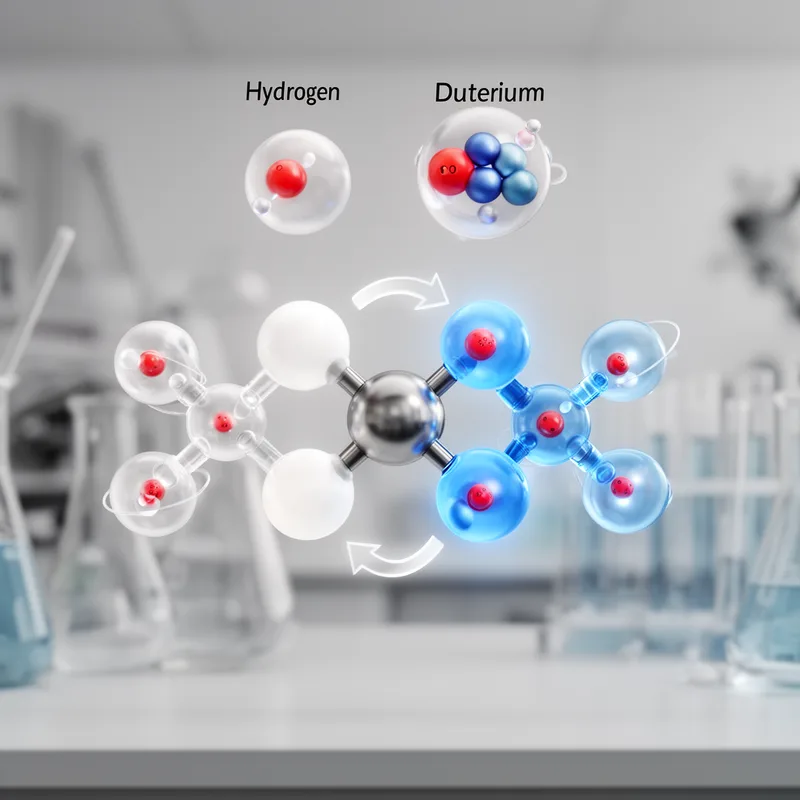
deuteride


 1
9.9
- noun
- /djuːˈtɛraɪd/
- Specialized
- In the laboratory, scientists demonstrated how deuteride can replace hydrogen in chemical reactions.
- lithium deuteride
Examples
-
A year later, in September 1947, Teller issued a report proposing a new thermonuclear fuel for the Alarm Clock: lithium-6 deuteride.
Academic text (1996) -
Lithium deuteride is used as fuel in some nuclear fusion reactors.
-
Researchers are studying deuteride compounds for their unique chemical properties.
Surface Forms
Morphology
deuteride = deuterium (semi-transparent) = deuter + ide
Formed from the name of the isotope 'deuterium' with the chemical suffix '-ide'; recognizable to learners familiar with scientific naming but not to general B1 learners.
Etymology
Deuteride comes from deuterium, whose Greek root means 'second' and which is the 'heavy' form of hydrogen, plus the chemical ending -ide seen in names like oxide and chloride. So a deuteride is a compound where deuterium atoms replace normal hydrogen atoms.