
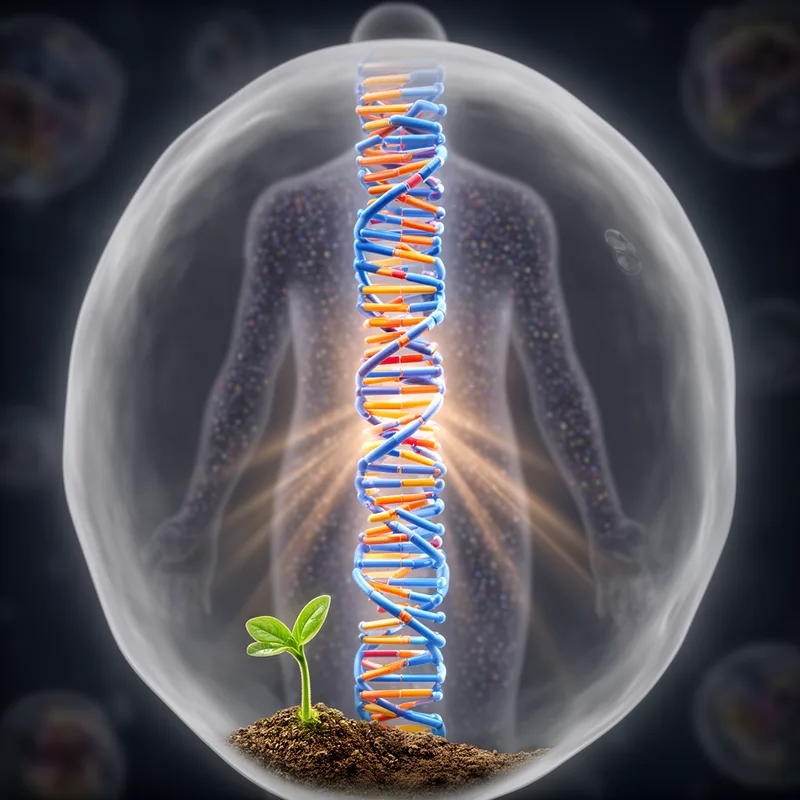
desoxyribonucleic acid
- noun
- /ˌdɛsoʊksɪˌraɪboʊnjuˈkliːɪk ˈæsɪd/
- UK
- Mutations in desoxyribonucleic acid can lead to various genetic disorders.
Examples
-
The structure of desoxyribonucleic acid was first discovered by Watson and Crick.
-
Scientists study desoxyribonucleic acid to understand genetic diseases.
-
Modern genetics is based on the understanding of desoxyribonucleic acid sequences.
-
The structure of desoxyribonucleic acid was discovered in the 1950s.
-
Modern genetics relies on desoxyribonucleic acid to understand heredity and genetic traits.
-
Research indicates that mutations in desoxyribonucleic acid can cause genetic disorders.
-
The double helix structure of desoxyribonucleic acid was elucidated by Watson and Crick.
Synonyms

 897
3.2
897
3.2

A long molecule in cells that carries genetic information for living things
Surface Forms
Morphology
desoxyribonucleic + acid
Only 'acid' is a common, transparent constituent; 'desoxyribonucleic' is a complex biomedical formation made of Greek/Latin roots (deoxy-, ribo-, nucleic) that a B1 learner will not know or be able to parse, so the specific meaning (DNA/genetic molecule) cannot be derived from the parts. Although many languages use similar cognate technical terms, the morphemes are specialized and the compound is essentially opaque to average B1 learners without prior exposure.
Etymology
Desoxyribonucleic acid is built from parts that describe the molecule: deoxy means 'without oxygen', ribo refers to a sugar, and nucleic acid points to a substance from the cell 'nucleus'. So the name tells you it is the long molecule in the cell's 'nucleus' that carries the 'genetic information' which tells living things how to grow and work.