
desmosome


 1
9.9
- noun
- /ˈdɛzməˌsoʊm/
- Specialized
- Cells in the skin rely on desmosomes for their strong adhesion, which is crucial during stretching.
Examples
-
However, although tight junctions are seen in arachnoid cells, the cell adhesion structures in meningiomas are desmosome-like.
Academic text (2007) -
Two factors that support this belief are that the kidney is a very vascular organ and that desmosomes are reduced in renal carcinoma cells.
Academic text (2001) -
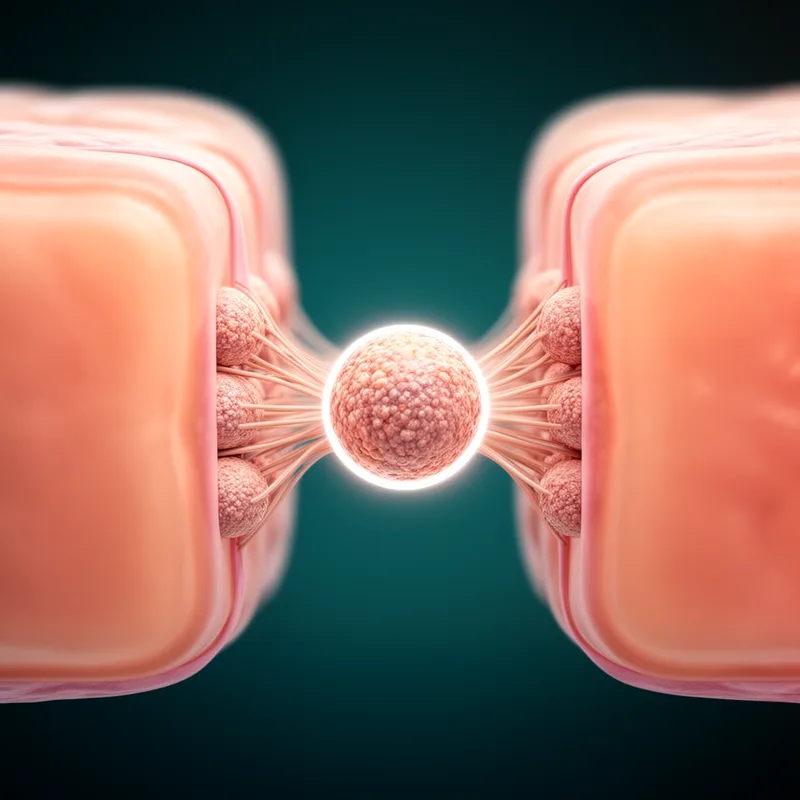
Tonofilaments in the cytoplasm converge on the desmosomal plaque; thus, desmosomes also serve as sites of attachment of the cytoskeleton to the cell surface.
Academic text (1995) -
The structure of a desmosome enables cells to adhere strongly to one another in epithelial tissue.
-
In healthy tissue, desmosomes are vital for maintaining the integrity of cell layers against mechanical stress.
Surface Forms
Morphology
desmosome = desmo + some
The components are specialized Greek combining forms ('desmo-' meaning bond and the technical suffix '-some'), which are not productive or familiar to an average B1 learner, so the meaning cannot be transparently derived from common English base words.
Etymology
Desmosome comes from Greek desmos 'bond' and soma 'body', so you can think of it as a 'bond between bodies'. That's why a desmosome is a small spot that holds cells tightly together, helping tissues like skin and heart stay strong.