
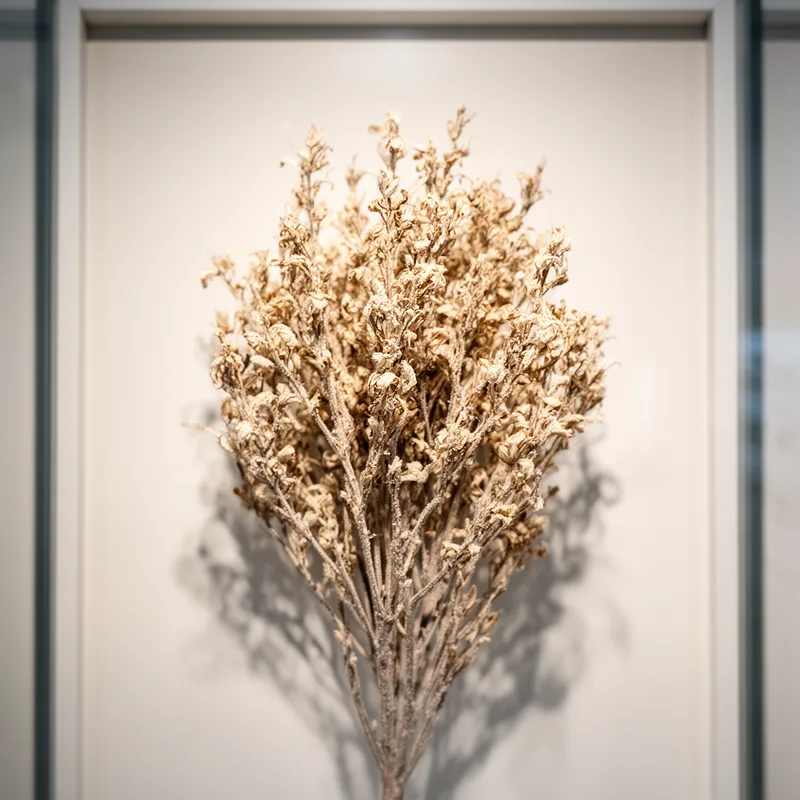
desiccated
- adjective
- /ˈdɛsɪˌkeɪtɪd/
- Specialized
- So what'll show up is like a little brown, almost like dry or desiccated look on the pepper.
Loading YouTube…
Watch on YouTubePerhaps in Abyssinia, as the land became desiccated, the sun was correctly seen as the source of all life and in excess the unstoppable taker of life.
- Perhaps in Abyssinia, as the land became desiccated, the sun was correctly seen as the source of all life and in excess the unstoppable taker of life.
Examples
-
- A DESOLATE, DESICCATED DESERT, UNTOUCHED BY THE HAND OF MAN AND GOD ALIKE.
-
Lee said, "That hardly appears open to question, sir, not after your repeaters, your desiccated foods—though I wish you might find a way to provide us with more of the latter—and now your ability to ferret out the Federals' plans."
Fiction book (1992) -
I mean, look at how desiccated that corn is.
-
Look at that nice and yellow, fully desiccated petals.
-
I remember thinking that her desiccated scalp had dried up from drinking, and her hair was thinning.
Fiction book (1999) -
An old woman, a child with drool on its chin, a deformed young girl and stunted broken trail, a desiccated tistandi.
-
Perhaps in Abyssinia, as the land became desiccated, the sun was correctly seen as the source of all life and in excess the unstoppable taker of life.
-
The desiccated fruits were packaged and sold as healthy snacks.
-
After months of storage, the desiccated herbs lost their vibrant color and flavor.
-
The scientist examined the desiccated soil samples to study their composition.
Synonyms

 18
3.5
18
3.5

No longer holds water and is very dry, like a riverbed or plant
 13
4.7
13
4.7
Having very little water because of heat
 8
2.8
8
2.8
Completely dry because it has no water left
 6
4.1
6
4.1
Food with most water removed by freezing and drying so it keeps for a long time
 5
3.2
5
3.2
Completely dry with no water left
 1
3.6
1
3.6
Food with most water removed so it lasts longer
 1
3.4
1
3.4
Completely dry with no moisture
 1
4.4
1
4.4
Left to dry in the air without using heat


 1
1.0
1
1.0
Something that is no longer wet because its water has gone away
Antonyms


How Dry

Surface Forms
Morphology
Etymology
Desiccated comes from Latin parts de- 'completely' and siccare 'to dry', so it literally means 'completely dried'. That's why we call food or plants desiccated when they have had all their moisture removed.