

dermoid cyst
- noun
- /ˈdɜr.mɔɪd saɪst/
- Specialized
- The doctor diagnosed her condition as a dermoid cyst and recommended surgery for its removal.
Examples
-
In our clinical experience, first branchial cleft anomalies are usually misdiagnosed as parotid tumors in middle-aged women or as dermoid cysts in young children.
Academic text (1998) -
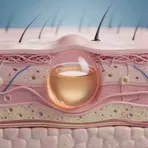
After the ultrasound, it was confirmed that she had a dermoid cyst that contained hair and skin cells.
-
The patient was relieved to learn that the growth was just a dermoid cyst and not a more serious condition.
Synonyms
 30
4.9
30
4.9

A small sac in the body often filled with fluid

A cyst present from birth that often contains skin, hair, or teeth and is not cancer

A small lump under the skin that is usually harmless and made from skin cells
Surface Forms
Morphology
The term is compositionally transparent: 'dermoid' (skin-like or relating to skin) combined with 'cyst' (an abnormal sac or structure) directly yields a cyst formed from or containing skin-derived tissues. This is a predictable medical morphological formation, so a B1 learner who knows both constituents can infer the basic meaning (a cyst involving skin-like tissue), even if specific details (hair, teeth) are specialist.
Etymology
Dermoid cyst comes from the Greek root 'derma' meaning 'skin' and the part dermoid shows this while cyst means a small sac. Because these cysts often hold pieces of 'skin', 'hair', or 'teeth', the name creates a clear picture of a 'skin-like' sac, which explains the meaning today.