
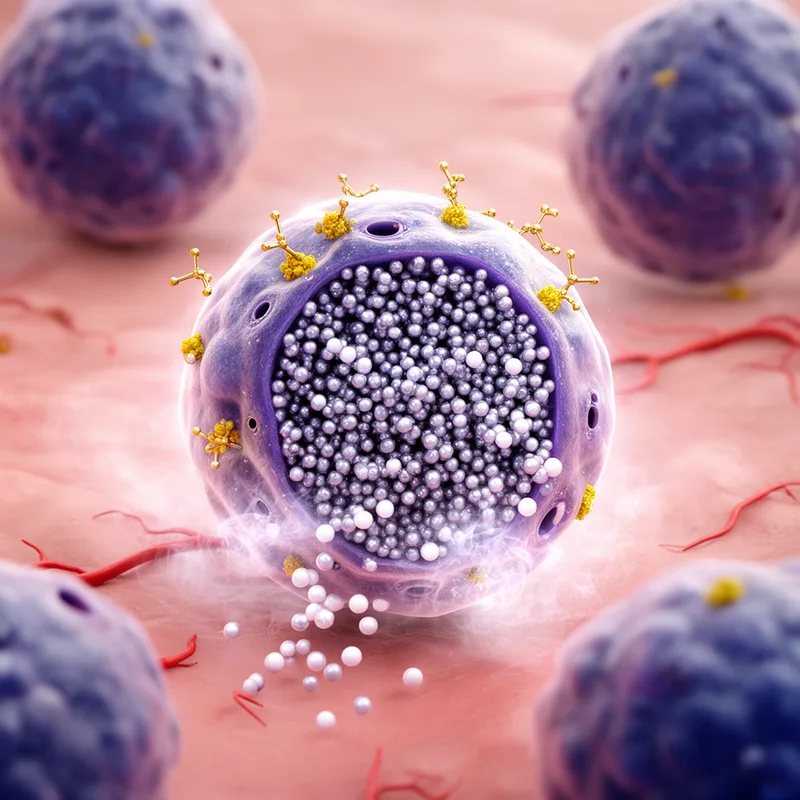
degranulation


 1
9.3
- noun
- /ˌdiːˌɡræn.jʊˈleɪ.ʃən/
- Specialized
- The process of degranulation is crucial for the immune response, as it helps to release chemicals that fight off allergens.
- mast-cell degranulation
- cell degranulation
Examples
-
Allergic rhinitis typically begins with the exposure of IgE-bound mast cells to an allergen and progresses to subsequent mast cell degranulation and histamine release.
Academic text (2005) -
During an allergic reaction, mast cells undergo degranulation and release histamine into the bloodstream.
-
Degranulation of these cells results in MPO secretion into extracellular space.
Academic text (2018) -
They probably modulate the proliferation and function of immune cells in these tissues as well as mast-cell degranulation.
Academic text (1996) -
It has also been shown that magnesium inhibits eosinophils from undergoing exocytosis and degranulation.
Academic text (2005) -
Yet, in mast cells, miR-155 expression inhibits degranulation and cytokine production (Figure 3) 82.
Academic text (2016) -
Anaphylactoid reactions are due to direct mast cell degranulation, whereas anaphylactic reactions are mediated by immunoglobulin E (IgE).
Academic text (2012) -
Researchers studied how the degranulation of immune cells impacts the severity of allergic reactions in patients.
Surface Forms
Morphology
degranulation = granulation (semi-transparent) = de + granul + ation
The structure is a regular prefixation (de- + granulation) with an obvious meaning 'removal/release of granules', but the technical medical sense and the stem alternation (granule → granul) may confuse some learners.
Etymology
Degranulation comes from the parts de- meaning 'remove' and granule meaning 'a small grain or packet'. So, degranulation is the idea of a cell 'removing' or 'releasing' its tiny chemical packets, which explains why the word is used for cells releasing granules in immune or allergic reactions.