
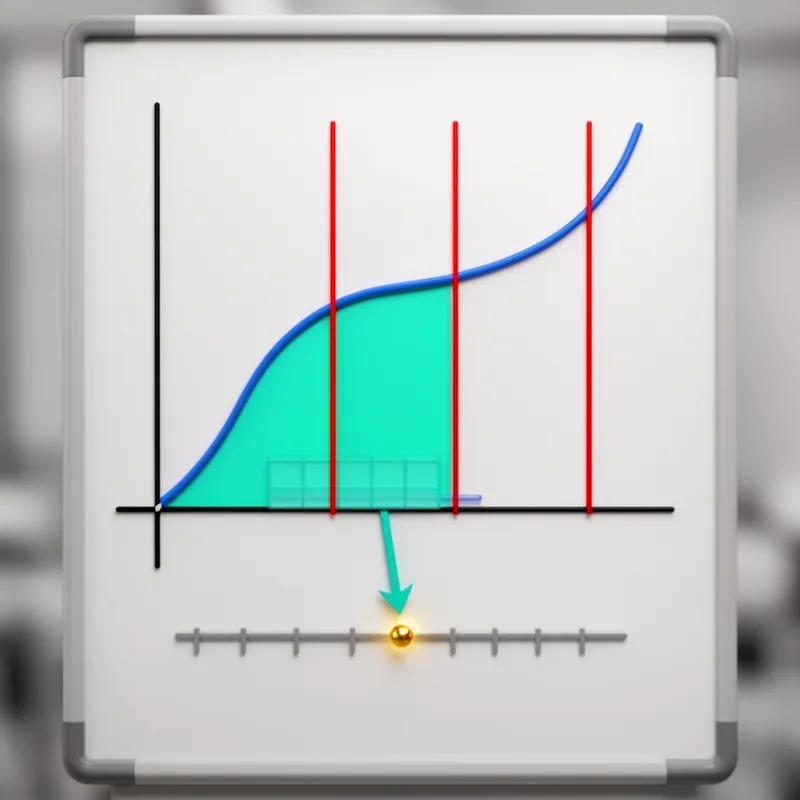
definite integral
- noun
- /ˈdɛfɪnɪt ˈɪntɪɡrəl/
- Specialized
- To find the area under the curve, we need to compute the definite integral from 0 to 1 of the function.
Loading YouTube…
Watch on YouTubeAnd then you have the definite integral from A to B, F of XDX.
- And then you have the definite integral from A to B, F of XDX.
- Calculus also shows us how to compute the definite integral so.
Examples
-
So little S is equal to the definite integral from zero to three of the square root.
-
And then you have the definite integral from A to B, F of XDX.
-
We can rescale all of our factors of K to find out what that definite integral is dependent on.
-
Well, we'll do a definite integral from MU W up to MU.
-
So this is how we evaluate the definite integral, plug in the top number, then subtract plug in the bottom number.
-
This was the time, after all, when I discovered definite integrals and antiderivatives and found my identity shifting from jock to math-wienie anyway.
Fiction book (1998) -
In calculus class, we learned how to evaluate the definite integral to calculate areas between curves.
-
The definite integral gives us the total accumulated value of the function across a specific interval.
Synonyms
 3
9.7
3
9.7

A function that shows the total area under the graph of another function
Surface Forms
Morphology
The phrase is compositionally transparent: 'definite' (specific, with stated limits) modifies 'integral' (the mathematical accumulation/area), so a learner who knows both words can infer an integral taken over a specific interval yielding a numerical value. This construction is also reflected in other languages (e.g. Spanish 'integral definida', French 'intégrale définie'), supporting predictability for learners.
Etymology
Definite integral comes from the simple idea of adding many tiny pieces to make a whole: the word integral means 'whole' and you can imagine summing thin slices under a curve. The word definite means the start and end points are 'fixed', so the calculation gives one number for the 'area' under the curve.