
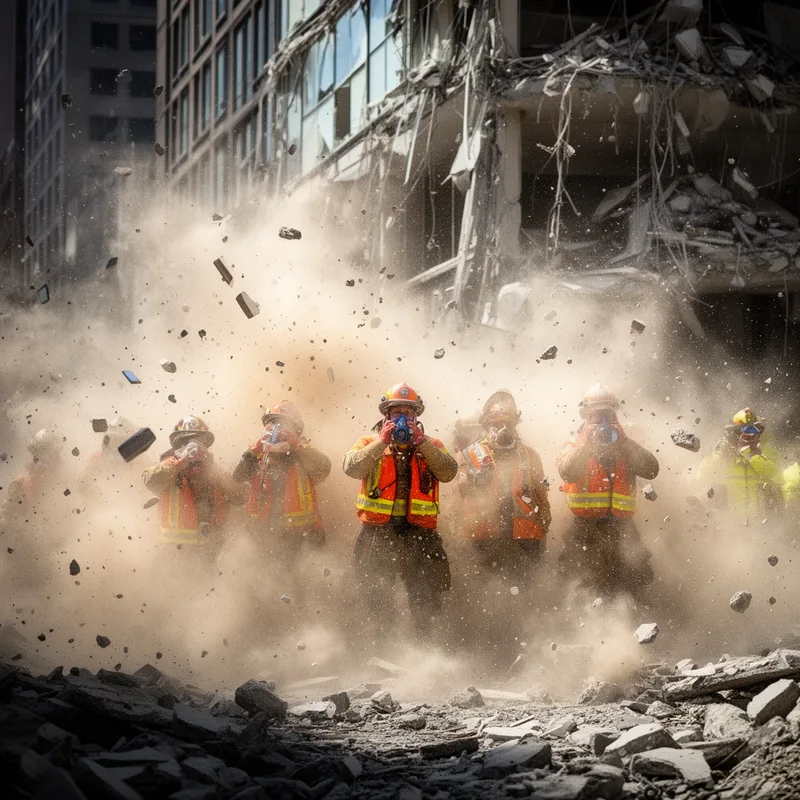
debris storm
- noun
- /dɪˈbriː stɔrm/
 :
tormenta de escombros
:
tormenta de escombros
- After the earthquake, a debris storm filled the air, making it difficult for anyone nearby to breathe.
Examples
-
Rescue workers struggled to see through the debris storm following the building's sudden collapse.
-
The explosion caused a massive debris storm that blanketed the entire street.
-
The debris storm created chaos in the streets.
-
After the explosion, a massive debris storm engulfed the area.
-
After the earthquake, a debris storm filled the air, making it difficult for anyone nearby to breathe.
-
Rescue workers struggled to see through the debris storm following the building's sudden collapse.
-
The explosion caused a massive debris storm that blanketed the entire street.
Synonyms

 18
2.2
18
2.2

Strong wind that lifts dust and sand into the air and makes it hard to see
 11
2.9
11
2.9
A visible cloud of fine dust hanging in the air

A sudden powerful rush of dust and pieces of a building after it collapses
How Intense

Surface Forms
Morphology
The meaning 'a sudden cloud or spread of dust and debris' is directly derivable from combining 'debris' (waste/remains) with 'storm' (a sudden, violent event); the phrase denotes a storm composed of debris. The metaphorical use of 'storm' as 'a sudden, intense occurrence' (a 'storm of X') is common cross-linguistically, so a B1 learner who knows both words will readily infer the meaning.
Etymology
Debris storm makes a clear picture: broken pieces and dust (debris) flying everywhere like a sudden storm (storm) when a building or wall falls. So it now means 'a sudden cloud of dust and debris' after a collapse or explosion.