
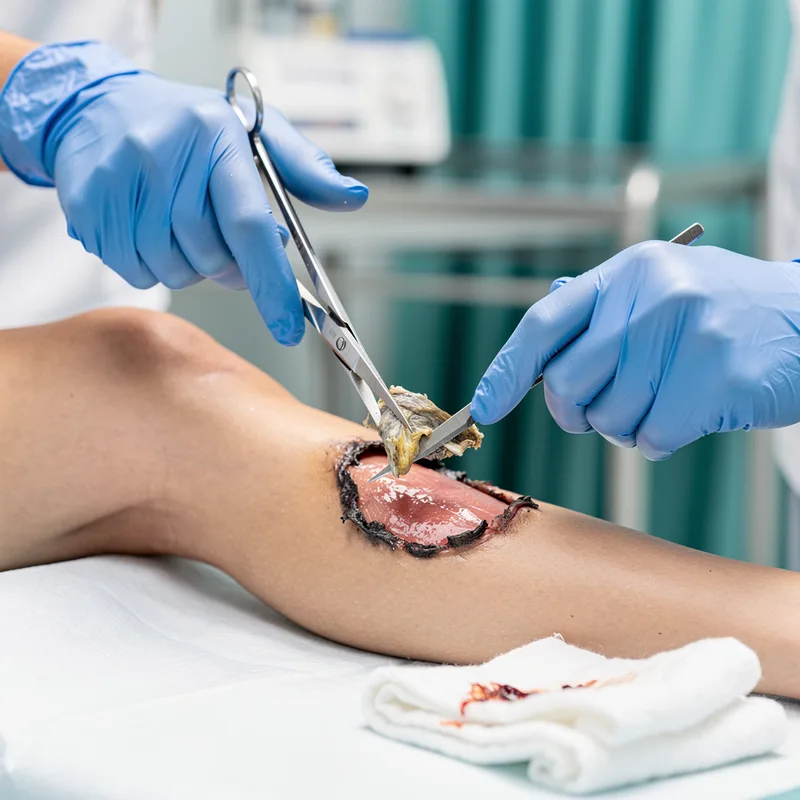
to debride
 3
9.5
3
9.5

- verb
- /dɪˈbriːd/
- Specialized
- Dr. Goodacre had to debride the bone and remove a portion of her skull.
- debride the wound
Examples
-
By doing this, Dr. Bent noted, the surgeon will not inadvertently suction and debride the posterior pillar.
Academic text (2004) -
Maggot therapy is effective and efficient in debriding non-healing foot and leg ulcers.
Academic text (2007) -
The necrotic muscle was debrided.
Academic text (2007) -
Pulsatile lavage is a portable method to debride wounds.
Academic text (2002) -
Four months later, the wound was debrided, and culture identified Escherichia coli.
Academic text (2003) -
The nail was removed and the right temporal lobe was debrided.
Academic text (2002) -
Another patient was debrided twice, at two separate times, and required a nasolabial flap to close a palatal defect.
Academic text (2005) -
The chondral defect has been debrided, and an osteochondral allograft has been inserted to fill the defect.
Academic text (2005) -
The soft tissue overlying the left nasal cavity was debrided widely, and his entire septum was excised.
Academic text (1995) -
The nurse needs to debride the wound to help it heal properly.
How Clean

Surface Forms
Etymology
Debride comes from the French word débrider, which means 'to take off a bridle' and is the same root as the English word bridle. So to debride a wound is like 'freeing' it by removing dead tissue so healthy skin can grow.