
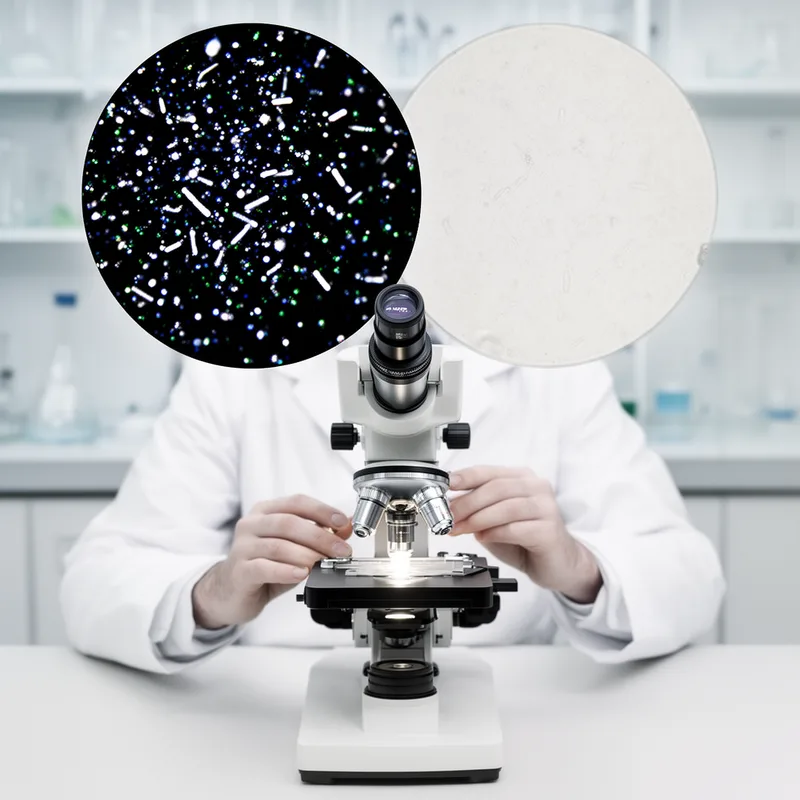
dark-field microscope


 1
6.8
1
6.8
- noun
- /dɑrk-fild maɪˈkrɒskoʊp/
- Specialized
- The dark-field microscope revealed tiny organisms in the water sample.
Examples
-
The biologist used a dark-field microscope to examine the bacteria invisible under normal illumination.
-
A dark-field microscope enables scientists to detect organisms that would be hidden in a regular bright-field setup.
-
Tiny particles suspended in liquid became visible when viewed through a dark-field microscope.
-
I used a dark-field microscope to observe the bacteria.
-
Researchers used a dark-field microscope to visualize the tiny bacteria in the sample.
-
With a dark-field microscope, scientists can observe particles that are otherwise invisible under normal lighting.
-
In their lab, they employed a dark-field microscope to enhance the contrast of their biological specimens.
Synonyms

A tool that uses light that bounces off tiny particles normal microscopes cannot see
How Detailed
- Specialized
1
4.7

- Specialized
1
6.8
Surface Forms
Morphology
dark-field + microscope
The phrase is compositionally built from 'dark-field' (a descriptive optical modifier) + 'microscope', so a learner who knows 'dark', 'field' and 'microscope' can infer it is a type of microscope producing a 'dark' background/field. However, the specific technical sense (illumination by scattered light to reveal very small particles) is domain-specific and not fully predictable from the constituents alone, so full comprehension requires specialised knowledge.
Etymology
Dark-field microscope is named for how the view looks: the field is the area you see and it is dark, while tiny things in the sample bounce light back and look bright. So, the name explains why this microscope helps you see very small particles that are hidden under normal light.