
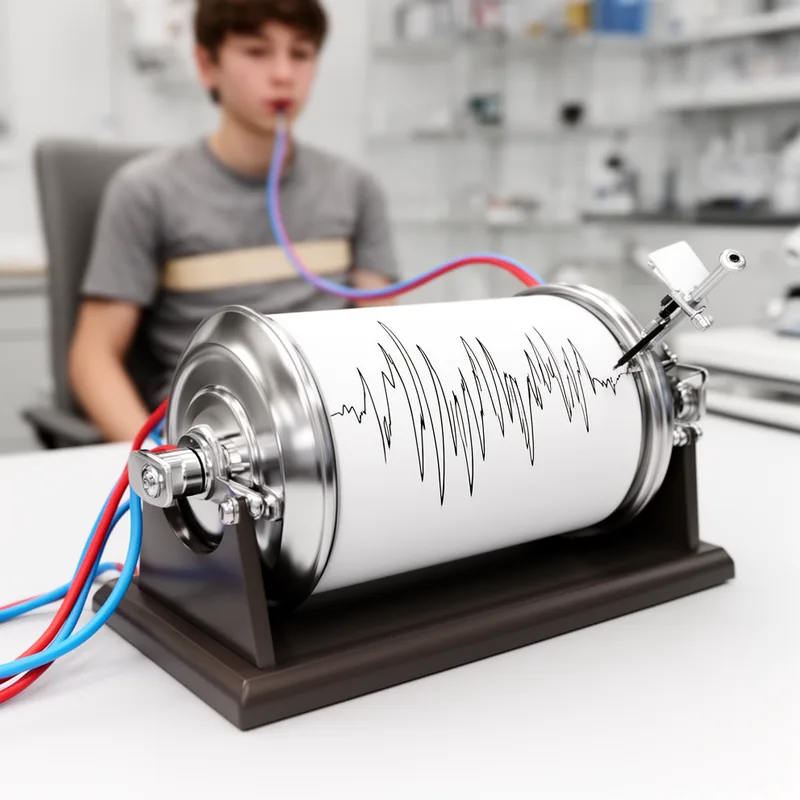
cymograph
- noun
- /ˈsɪməˌgræf/
- Archaic
- Early studies of respiration often employed a cymograph for continuous recording of breathing patterns.
Examples
-
Researchers use a cymograph to monitor breathing patterns.
-
The researcher used a cymograph to monitor the subject's pulse during the experiment.
-
A cymograph produces a visual trace, making it easier to analyze physiological changes over time.
-
The cymograph recorded my heart rate during the test.
-
The scientist analyzed the patient's health data using a cymograph, which displayed vital signs over time.
-
In the laboratory, the team employed a cymograph to capture continuous traces of the subject's breathing rate.
-
During the study, a cymograph was used to chart the fluctuations in blood pressure with precision.
Synonyms
A machine that records body movements, like breathing and blood pressure, by drawing lines on a turning paper drum
Surface Forms
Morphology
cymograph = cymo + graph
The word is built from classical combining forms meaning roughly 'wave' and 'record/write', but that composition is not transparent to an average B1 learner.
Etymology
The word cymograph comes from the Greek parts kyma ('wave') and -graph ('to write' or 'record'). So a cymograph is a 'wave-writer' that draws a continuous line on a moving drum to show things like breathing or blood pressure.

