

cyclopean
 1
9.9
1
9.9

- adjective
- /saɪˈkloʊpiən/
- Many of these, such as Knossos, Mycenae, Pylos, and Tiryns, are on every tourist schedule today with impressive ruins and 'cyclopean walls' (so called because they were so large that they could only have been built by the legendary Cyclops).
- cyclopean eye
Loading YouTube…
Watch on YouTubeBut with with Nietzsche, you don't have like, you know, cyclopean elder gods.
- But with with Nietzsche, you don't have like, you know, cyclopean elder gods.
- He says that they came upon a coastline of mingled mud ooze and weedy cyclopean masonry.
Examples
-
Although the cyclopean red eye in the center of Samson's forehead didn't turn my way, I knew that he could see me nonetheless.
Fiction book (2000) -
Things frolicked and swayed amid cyclopean ruins, dancing blindly and madly to a silent alien beat.
-
St. Ed looked up from his food to see the cyclopean gray eye of a TV camera glaring at him.
Fiction book (1993) -
At the top, a cushionlike form sits precariously and seems to look out and away from the sculpture, like a cyclopean eye.
Academic text (2012) -
The ancient ruins were guarded by cyclopean walls, towering over the landscape with their massive stone structure.
-
In the dark cave, a cyclopean statue loomed, its single eye watching over the hidden treasures.
-
The artist's latest sculpture depicted a cyclopean creature, showcasing its massive eye and imposing form.
Synonyms
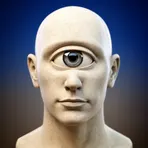
Having one eye in the middle of the forehead
Compounds

- Specialized
A style of building using very large rough stones placed together without mortar, often in ancient walls
How Big

Surface Forms
Morphology
Etymology
Cyclopean comes from the name Cyclops, the one-eyed giant of Greek myth, and from the Greek parts kyklos 'circle' and ops 'eye'. The same kyklos appears in the English word cycle meaning 'circle', so cyclopean is used for something very large or that looks like a single huge eye.