
cycloid
 1
9.9
1
9.9

- noun
- /ˈsaɪklɔɪd/
- Specialized
- That must mean that the earth's orbit actually follows a very complicated cycloid about the barycenter as the sun follows its smaller path around the barycenter.
Examples
-
Collisions of the electrons with gas molecules cause the electrons to start new cycloids—fortunately always closer to the center of the beam.
Academic text (2006) -
It corresponds to a cycloid, and you may not remember what a cycloid is.
-
Maybe on the cycloid would say it's the distance starting from the origin.
-
So that's a cycloid, so you can do more than one roll.
-
Similarly, by the same token, this black dot is describing a sequence of upside down cycloids whose lobes are hanging from the ceiling like this.
-
Lee (23:42:50): That must mean that the Earth's orbit actually follows a very complicated cycloid about the barycenter as the sun follows its smaller path around the barycenter.
Blog text (30) -
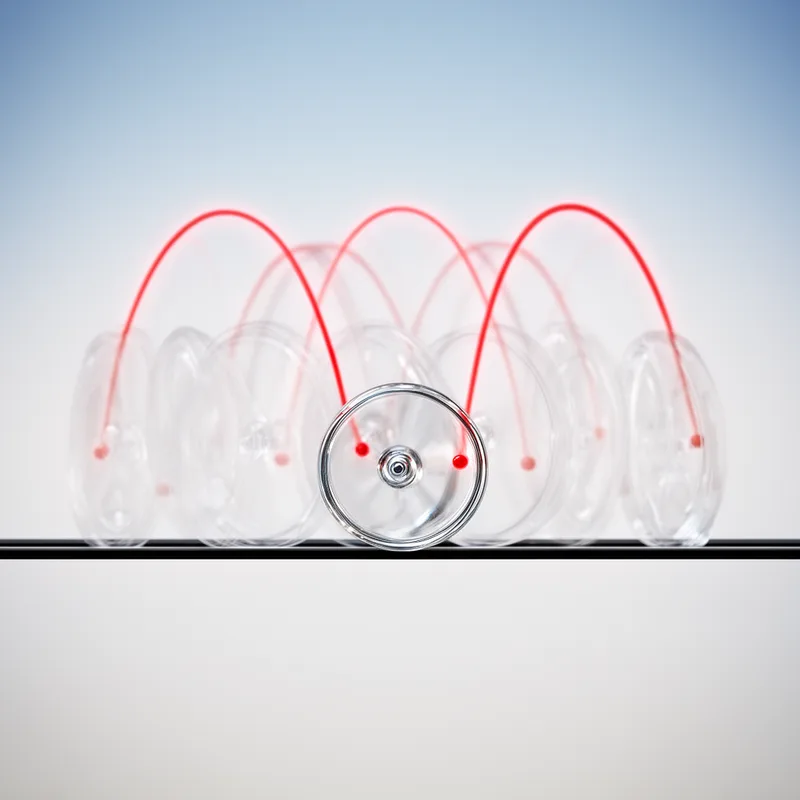
A cycloid is formed when a circle rolls along a straight line without slipping, tracing an elegant curve.
-
The cycloid's unique shape makes it a subject of interest for many mathematicians studying curves.
-
In physics, the cycloid is important for understanding the motion of objects like rolling wheels.
Compounds

- Specialized

 1
9.9
1
9.9
A curved line made by a point inside a circle as the circle rolls along a straight line

Surface Forms
Morphology
cycloid = cycle (semi-transparent) = cyclo + oid
Formed from cycl(o)- 'circle' + -oid 'like/resembling'; the technical mathematical meaning (specific curve traced by a rolling circle) is more specialized than a simple 'circle-like' inference.
Etymology
Cycloid comes from an old Greek word for 'circle', with the parts cycl- ('circle') and -oid ('like' or 'shape of'). Think of the tip of a bicycle wheel drawing a line as the wheel rolls — the path of that rolling circle is a cycloid, so the word means a 'circle-like' curve made by a moving circle.