
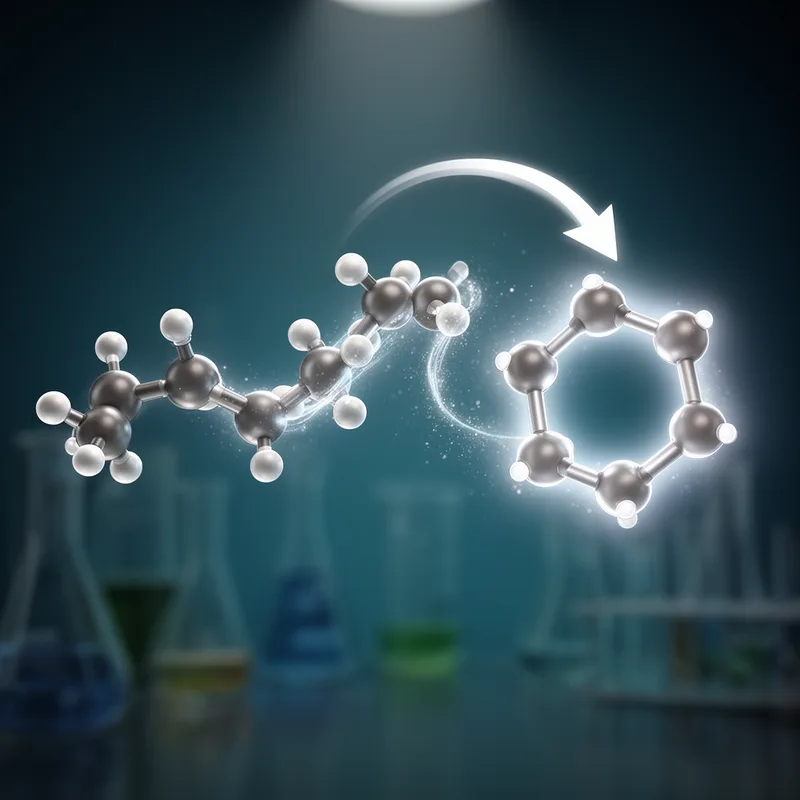
cyclization
- noun
- /ˌsaɪklɪˈzeɪʃən/
- Specialized
- The chemist observed that the cyclization of the polymer led to a much more stable structure.
Examples
-
OK, so remember that I told you that terpenoids do cyclizations and one way they can do it is to protonate the olefin.
-
Figure 1 demonstrates that the total weight loss in stage II, stage III, and stage IV is 10.1 wt%, which corresponds to the removal of the existing solvents and the elimination of water molecules during the polymer cyclization process.
Academic text (2018) -
The limited increase in the degree of imidization is considered to be caused by severely restricted chain mobility after cyclization.
Academic text (2018) -
During the experiment, the cyclization resulted in the formation of a complex ring structure.
-
Researchers studied how temperature affects the rate of cyclization in various organic compounds.
Surface Forms
Morphology
cyclization = cyclize (semi-transparent) = cycl + ize + ation
The step from the verb 'cyclize' to the noun by adding '-ation' is a regular, productive nominalization.
Etymology
Cyclization comes from the root cycl- meaning 'circle', the same root as cycle and bicycle, and the ending -ization meaning 'the process of'. So, cyclization is the process of turning a chain of atoms into a ring or 'circle' in a molecule, which is why chemists use the word for making ring structures.

