
cyclin
 1
8.9

- noun
- /ˈsaɪklɪn/
- Specialized
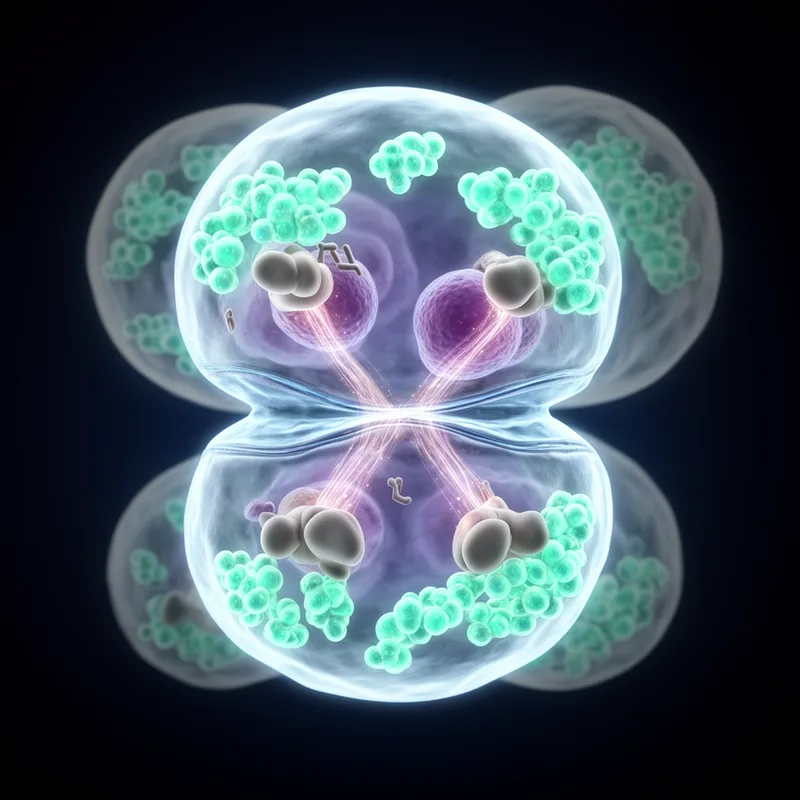
- In the 1980s and 1990s, she conducted pioneering research on cyclins, proteins that drive cells through the cell division cycle.
- cyclin-dependent kinase
- cyclin-dependent
- cyclin/CDK complex
Examples
-
However, the degree to which cellular genes depend on cyclin T1 versus cyclin T2 is currently unknown.
Academic text (2018) -
Significance: This mouse model establishes the significance of this modification for the nuclear accumulation of cyclin D1-CDK4.
Blog text (18) -
However, depending on the cyclin/CDK heterodimer targeted, the interaction shows remarkable differences.
Academic text (2017) -
For several years, the capability to inhibit the cyclin/CDK complexes has remained the exclusive p27 function.
Academic text (2017) -
First, although p27 inhibits cyclin D/CDK4 and cyclin A/CDK2 with a similar efficiency, significant changes in the enthalpy/entropy balance associated with the binding were reported.
Academic text (2017) -
Moreover, a recent report showed that p27 and stathmin interaction down-regulates H-Ras/MAPK and cyclin D/CDK4(6) activities.
Academic text (2017) -
Since p27 inhibits cyclin E(A)/CDK2 activity, the involvement of CDK2 in p27 degradation appears, at first glance, quite obscure.
Academic text (2017) -
p27Kip1 (hereinafter reported as p27) was identified as a protein able to bind and inhibit the activity of the cyclin E/cyclin-dependent kinase 2 (CDK2) complex 1-3.
Academic text (2017) -
In cancer research, scientists study how cyclin proteins regulate the cell cycle and influence tumor growth.
-
The role of cyclin in controlling cell division is crucial for understanding cancer progression.
Surface Forms
Morphology
Etymology
The word cyclin comes from the Greek root cycl- meaning 'circle' or 'cycle', the same root you see in cycle, and the ending -in is a common name for a protein. These proteins rise and fall in a repeating cycle, so the name helps you remember they control the cell 'cycle'.