

cycle rickshaw


 1
3.9
1
3.9
- noun
- /ˈsaɪkəl ˈrɪkʃɔː/
- The government functionaries extort Rs 10 million a month from the cycle-rickshaw pullers!
Examples
-
Delhi has approximately 500,000 cycle-rickshaws providing an affordable and accessible transportation service to the poor.
Blog text (19) -
Dust, cobwebs, rusty pipes, the flowers outside, the squeal of a cycle-rickshaw brake, the stain in the cup of the washbasin, every grain of sand in the compound.
Fiction book (2002) -
Delhi has a law that the owner and the driver of a cycle rickshaw must be the same person.
Blog text (19) -
More than 80% of the cycle-rickshaws are illegal.
Blog text (19) -
Studies suggest that, on average, a bribe of Rs 200 per month per cycle rickshaw is paid.
Blog text (19) -
Consider cycle-rickshaw pullers and street vendors in the cities and towns of India.
Blog text (19) -
But anyone wanting to run a tea stall, become a street hawker, a cycle rickshaw puller, or work as a railway porter requires a license.
Blog text (19) -
A cycle rickshaw-walla pulled into a passer of bikes, raised the canopy over his bench, and went to sleep, folding himself into a two-foot fetus.
Fiction book (1996) -
In busy cities, many people rely on a cycle rickshaw for affordable transportation.
-
It's common to see a cycle rickshaw weaving through traffic on the streets of Delhi.
Synonyms
 2
8.1
2
8.1
A small bike with three wheels that a person pedals to carry people for money
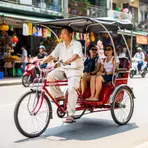 1
8.8
1
8.8
A three-wheeled bicycle taxi that carries people in some Asian cities
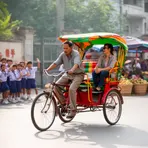 1
7.0
1
7.0
A three-wheeled bike with a seat for carrying people
How Big

Surface Forms
Morphology
The meaning is directly compositional: 'cycle' specifies the propulsion type of the 'rickshaw', so a learner who knows both words will infer a rickshaw powered by pedaling. Although 'rickshaw' has regional variants (pulled or motorized), the modifier 'cycle' clearly signals a pedal-powered three-wheeled passenger vehicle, making the expression predictable.
Etymology
Cycle rickshaw comes from combining cycle and rickshaw: cycle means a bicycle and rickshaw was a small cart for people. Picture a bicycle changed to carry passengers with an extra seat and wheel, with the driver pedalling, and you can see why it means 'a small three-wheeled vehicle usually pedalled to carry passengers for hire'.