
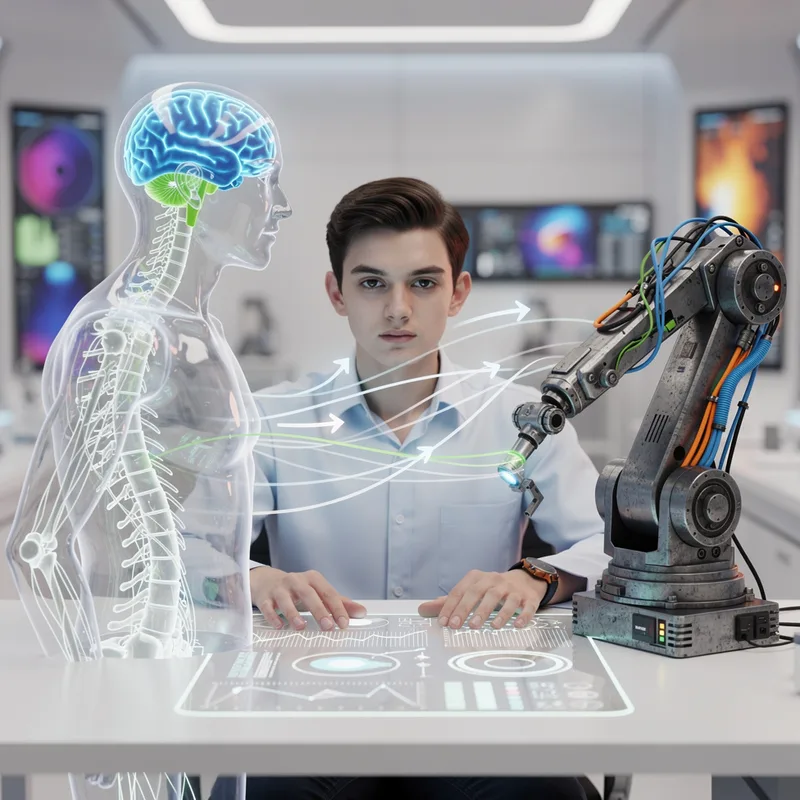
cybernetics
 5
9.0

- noun
- /ˌsaɪbərˈnɛtɪks/
- Specialized
- The principles of cybernetics apply to both natural systems and artificial intelligence technologies.
- theories of cybernetics
- cybernetics and information
- cybernetics in systems
Loading YouTube…
Watch on YouTubeMy friend Oliver Selfridge, who died recently, was a pioneer in cybernetics and AI.
- My friend Oliver Selfridge, who died recently, was a pioneer in cybernetics and AI.
- And he's the guy who came up with this word cybernetics, which means the interface between humans and machines.
- This is Foundations of relational systems feedback loop it's called in cybernetics.
- And I want to say it's the cybernetics is that computer brain interfacing and stuff like that.
Examples
-
My friend Oliver Selfridge, who died recently, was a pioneer in cybernetics and AI.
-
Careful planning and the incorporation of cybernetics will guarantee the economic boom in the land.
Academic text (2007) -
The process is described by cybernetics in systems that have the capacity for learning and adapting.
Academic text (2000) -
However, all that is clear from Wiener's work is that cybernetics is a theory of regulated and especially self-regulating systems.
Academic text (1996) -
Research in neurophysiology and cybernetics has revealed that self-steering cannot be formalized into some trivial, objective natural laws.
Academic text (1991) -
Cybernetics examines how information flows in both cybernetics and machines.
-
Researchers in cybernetics focus on understanding communication processes in complex systems.
Surface Forms
Morphology
cybernetics = cybernetic (semi-transparent) = cybernet + ics
The formation parallels other -ics field names (e.g., 'linguistics') where an adjective/combining form yields the name of a discipline.
Etymology
The word cybernetics comes from the Greek kybernetes, meaning 'steersman' or 'pilot', from kybernan 'to steer'. So, think of cybernetics as the study of how systems 'steer' or 'control' themselves, the same idea behind the word govern, which is why it looks at how information guides living and machine systems.