
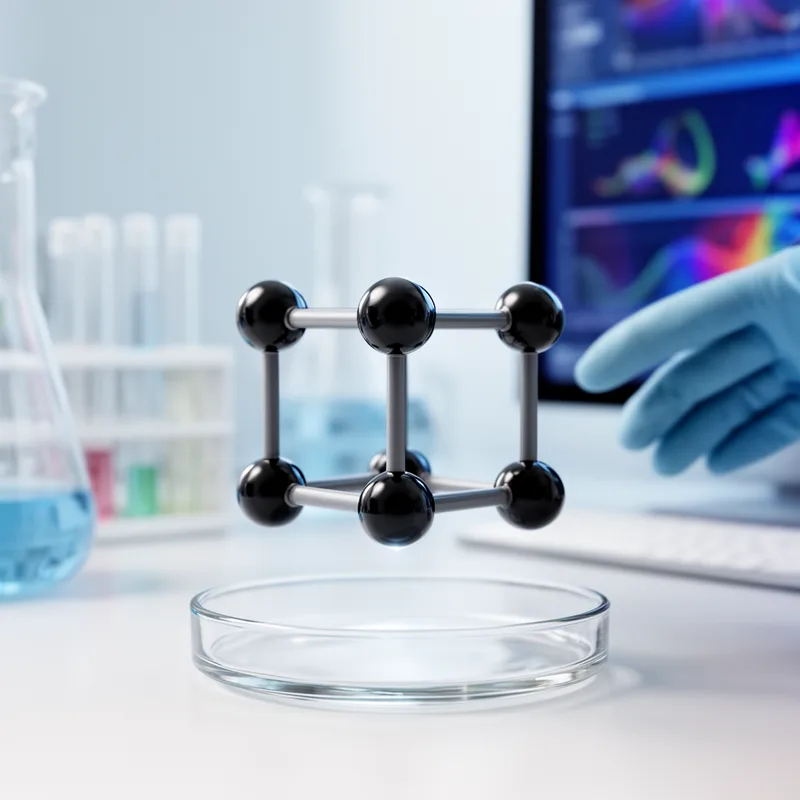
cubane
9.9
A small chemical made of eight carbon atoms in a cube shape used in research
- noun
- /ˈkjuːbeɪn/
- Specialized
:
cubano
- Scientists have synthesized a new compound based on cubane to improve drug delivery systems.
Examples
-
Researchers discovered that cubane derivatives exhibit unique properties in pharmaceutical applications.
-
In their experiment, the team used cubane as a model to study molecular stability.
-
Researchers are only beginning to understand cubane's oxidation states using crystallography and spectroscopy (see J.-Z. Wu et al., ref. 6).
Academic text (2004) -
The basic constituent of the catalyst that splits water during photosynthesis is cubane (top) — clusters of manganese and oxygen.
Academic text (2004)
Surface Forms
Morphology
Etymology
Cubane comes from cube and the chemical ending -ane, so the word points to a 'cube' shape. That's why cubane is a molecule with eight carbon atoms arranged like a cube, and the -ane ending—seen in words like methane—helps you remember it is a carbon-based molecule.

