
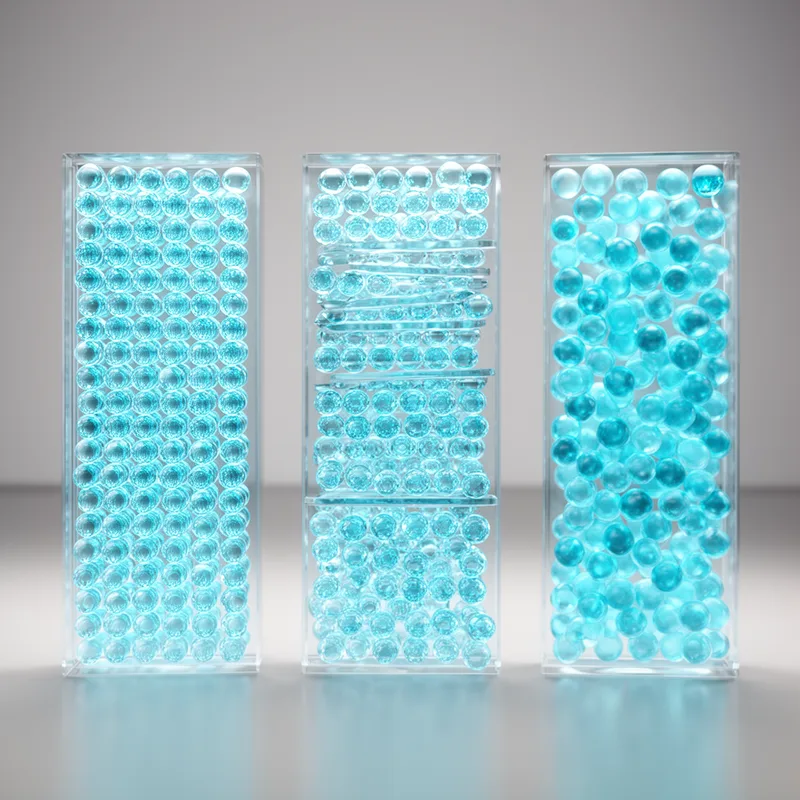
crystallinity


 1
8.4
- noun
- /ˌkrɪs.təˈlɪn.ɪ.ti/
- Specialized
- The calculation of crystallinity by XRD is based on the presumption that the broad peak comes from amorphous phases; the sharp peak comes from crystal phases.
- degree of crystallinity
- increase in crystallinity
Examples
-
The researchers measured the crystallinity of the new material using X-ray diffraction techniques.
-
The above results, along with the crystallinity percentage, are reported in Table 3.
Academic text (2018) -
Thus, it is important to determine the degree of crystallinity.
Academic text (2018) -
More recently, they have been able to improve the crystallinity of the upper iron electrode by growing it at temperatures above room temperature.
Academic text (2004) -
The particles are loosely packed due to an inadequate degree of crystallinity.
Academic text (2018) -
As pyrolysis temperature increased, the aromaticity, crystallinity, and ash content increased.
Blog text (11) -
Thus, EDC high-FNP had the highest crystallinity, which led to a well-arranged structure with a sharp boundary and no observable aggregation.
Academic text (2018) -
Determining the crystallinity of a solid is essential for understanding its physical properties.
-
The high level of crystallinity in the sample indicated that it was well-structured and stable.
How Crystalline

Surface Forms
Morphology
crystallinity = crystalline (transparent) = crystal + ine + ity
The noun is a straightforward nominalization of 'crystalline' with '-ity' indicating the degree or quality of being crystalline.
Etymology
The word crystallinity comes from crystal, meaning a clear, hard piece of material, and the ending -ity, meaning 'state' or 'quality'. So crystallinity is the 'how much' a material is like a crystal — how ordered and regular its internal structure is, which explains why it affects strength and transparency.