

crusader
 27
8.1
27
8.1

- noun
- /kruːˈseɪdər/
- The crusader fought valiantly to recapture Jerusalem from its captors.
- Crusaders entered Jerusalem
- crusader knight
- crusader kingdom
Loading YouTube…
Watch on YouTubeI'll show you a slide of Jerusalem only being the capital of the Crusader Empire and the Jewish Empire.
- I'll show you a slide of Jerusalem only being the capital of the Crusader Empire and the Jewish Empire.
- How is it that The Crusaders didn't destroy the dam of the rock or the AL Aqsa mosque?
- The ruler of Egypt gave a plea to Nuruddin, the Sultan of of of in Palestine, asking for his help against The Crusaders.
Examples
-
Nearby lie the ruins of one of the largest crusader castles in the Middle East.
Academic text (2001) -
In July of 1099, almost a year after the bishop's death, the crusaders succeeded in entering the city.
Academic text (1991) -
The crusader, Robert Loxley, has returned this past week.
-
I was Robin of Loxley, a Crusader under the flag of the King of England.
-
Deschamps and Thibout recognized crusaders, with red crosses on their helmets, among the combatants in the siege.
Academic text (1991) -
History remembers the crusaders for their battles during the medieval holy wars.
-
Many stories recount the journeys of the crusaders who traveled long distances to fight in the Holy Land.
Synonyms
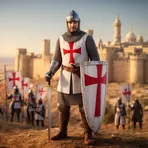
A person who fought in the medieval Crusades
Compounds

Surface Forms
Morphology
Etymology
The word crusader comes from crusade, which comes from the Latin crux meaning 'cross'. In the Middle Ages people who joined those holy wars wore a cross on their clothes and said they had 'taken the cross', so a crusader was a warrior who fought in those campaigns.