
cross section
 1
7.2
1
7.2

- noun
- Specialized
 :
sección eficaz
:
sección eficaz
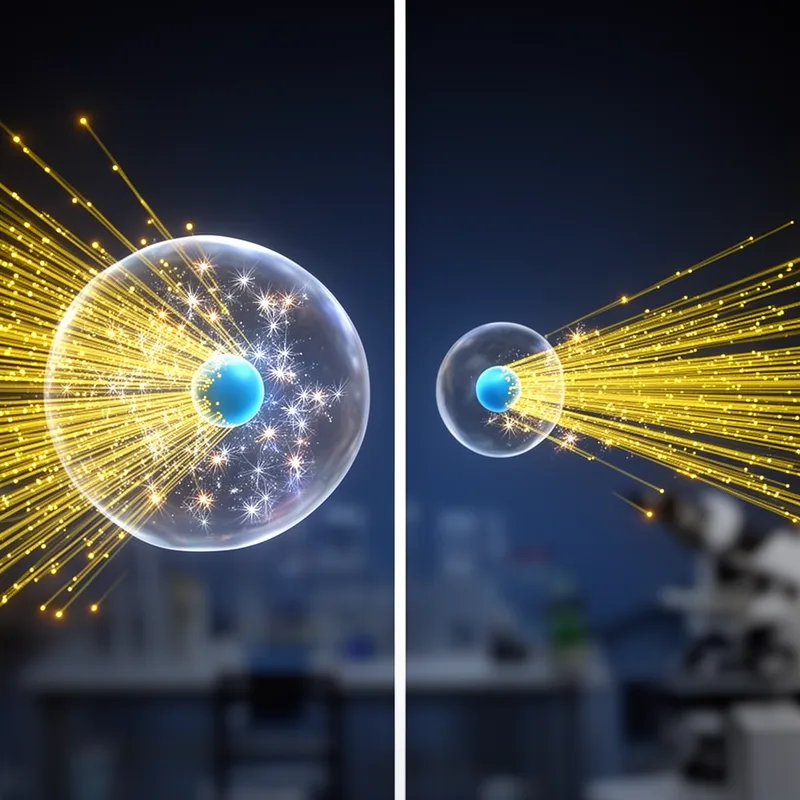
- In particle physics, the cross section indicates the likelihood of a specific interaction occurring between two colliding particles.
- reaction cross sections
- photoproduction cross sections
- absorption cross section
Weakly interacting means that it has cross sections and properties consistent with the weak interactions.
- Weakly interacting means that it has cross sections and properties consistent with the weak interactions.
- It seems like soft X-rays in metal have actual actually relevant cross sections for interaction in the non linear regime.
- So it's mathematics in cross sections is governed by resonances.
Examples
-
Weakly interacting means that it has cross sections and properties consistent with the weak interactions.
-
We said that our total cross section is scattering plus absorption.
-
The total cross section is given by this sum.
-
The experimental data included the D-T and 3He-D reaction cross sections.
Academic text (1996) -
After hole theory was formulated, his calculations of cross sections for pair production and bremsstrahlung became classics.
Academic text (2005) -
The report concluded that detonation of pure D was feasible if the cross sections of secondary reactions were sufficiently large.
Academic text (1996) -
On the other hand, the cross sections of x-ray scattering are small, and x-rays ultimately cause damage to organic molecules.
Academic text (1995) -
Experiments at the ISR revealed the logarithmic rise of the pp total scattering cross section at energies where it was expected to have leveled off.
Academic text (2012) -
To detect low-energy neutrons, one usually employs one of three reaction targets: 3He, sup10B, and sup6Li, whose cross sections are shown.
Academic text (2004) -
Scientists often refer to the measured cross sections when discussing the results of particle collision experiments.
Surface Forms
Morphology
The basic composition 'cross' + 'section' transparently evokes the literal notion of an area produced by slicing (a cross-sectional area), which a B1 learner could grasp. However, the physics sense (a probabilistic 'effective area' measuring interaction likelihood) is a metaphorical extension that requires disciplinary knowledge and is not directly derivable from the constituents, so it is only partially transparent.
Etymology
Cross section in physics uses the image of a target area that something can hit. Imagine throwing darts at a target: a bigger 'cross section' is a bigger target and so gives a higher 'chance' of a hit, which is why scientists use it to mean the probability of an interaction.