
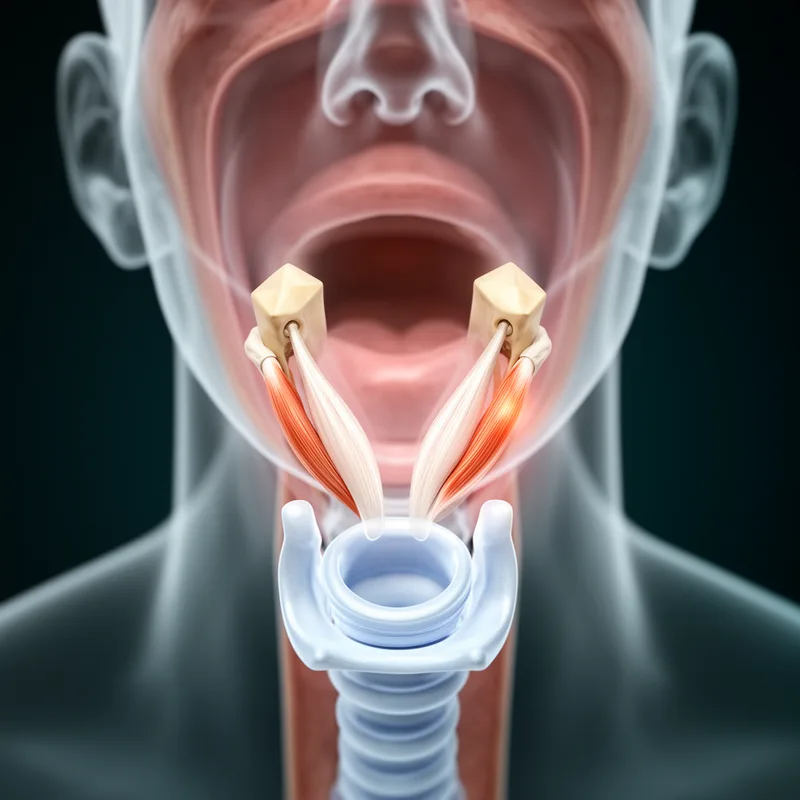
cricoarytenoid
- noun
- /ˌkraɪkoʊˈɛrɪtɪnɔɪd/
- Specialized
- The cricoarytenoid muscle plays a crucial role in adjusting tension in the vocal cords.
- cricoarytenoid joint
- posterior cricoarytenoid
Examples
-
The amount of resting muscle tone in our patient was insignificant because passive motion of the arytenoids (when palpated separately) was easily demonstrated, indicating that the cricoarytenoid joint itself was not fixed.
Academic text (2006) -
The cricoarytenoid joints were mobile, but abduction was limited by the tissue band.
Academic text (2009) -
The value of imaging for definitive information about the cricoarytenoid joint is therefore limited.
Academic text (2006) -
The next step after a normal EMG is the evaluation of the cricoarytenoid joints and posterior laryngeal area.
Academic text (2006) -
(n6) CT of the cricoarytenoid joints can be more difficult to interpret when there is insufficient mineralization of the laryngeal cartilages, as is the case with younger patients.
Academic text (2006) -
During the procedure, the surgeon examined the condition of the cricoarytenoid structure in detail.
-
An injury to the cricoarytenoid joint can affect a person's ability to speak clearly.
Surface Forms
Morphology
Etymology
Cricoarytenoid combines the names cricoid ('ring') and arytenoid ('small cartilage near the vocal cords'), so a cricoarytenoid is a structure that links those cartilages and helps move the vocal cords.

