
cremaster


 1
9.9
- noun
- /ˈkrimˌæstər/
- Specialized
- Thus, this makes the cremaster flap a unique model for microcirculatory monitoring.
- cremaster muscle
- cremaster flap
Examples
-
Following euthanasia, the cremaster muscles were harvested from each of the animals.
Academic text (2015) -
To address these questions, we used the rat cremaster muscle flap.
Academic text (2015) -
Three regions of the cremaster muscle were observed for 2 minutes each, and the number of rolling and sticking leukocytes was counted.
Academic text (2015) -
In the control group (n=10), the cremaster muscle was sprayed with room temperature water for 4 seconds at a distance of 18 cm.
Academic text (2015) -
While the cremaster model is ideal for real-time evaluation of the microcirculation, it is a muscle flap that lacks a skin component.
Academic text (2015) -
The significant increase in myeloperoxidase activity and neutrophils found within the cremaster muscle suggests some type of short-lived inflammatory response (17).
Academic text (2015) -
The cremaster muscle was harvested, immersed in 500 L phosphate-buffered saline (PBS), and then homogenized.
Academic text (2015) -
However, the cremaster flap represents a unique model with a neurovascular pedicle independent of surrounding tissues and is significantly better than random pattern flaps, which represent models not directly applicable to the field of reconstructive surgery.
Academic text (2015) -
Also, the cremaster muscle is thin—only 25 m to 300 m in thickness—and, as such, can be transluminated, allowing for direct monitoring of microvascular hemodynamics and cellular interactions.
Academic text (2015) -
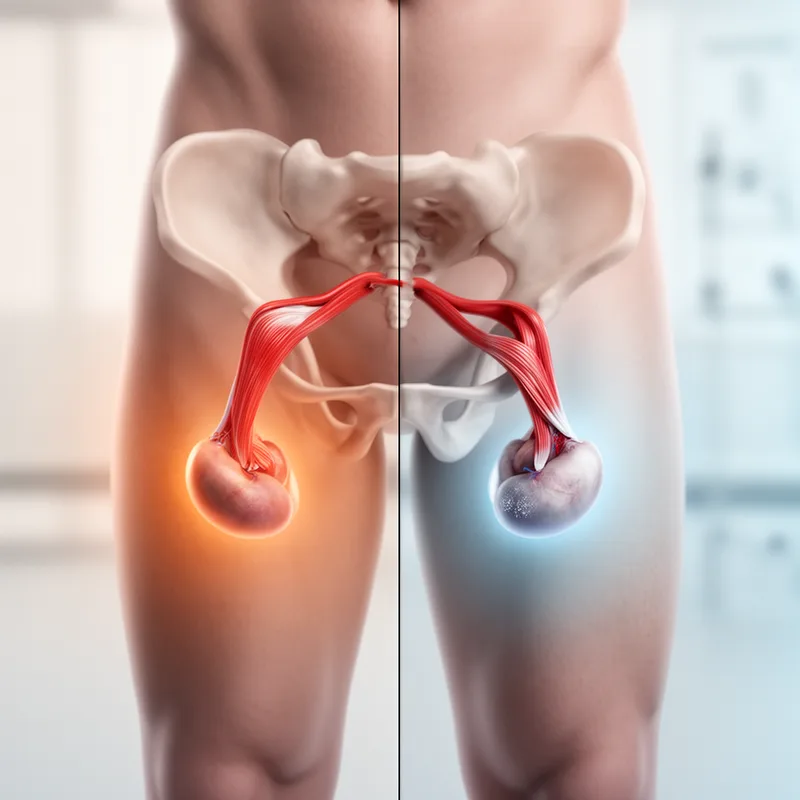
The cremaster muscle contracts to pull the testicle closer to the body in colder temperatures.
Surface Forms
Etymology
Cremaster comes from an old Greek word kremastēr meaning 'hanger' or 'to hang'. That's why the cremaster muscle 'hangs' the testicle and can pull it up or let it down to help control temperature.