

to crater
 2
4.7
2
4.7

- verb
- /ˈkreɪtər/
- The Moon's cratered surface records an ancient chapter in the evolution of our own planet, one largely erased on Earth.
Examples
-
We speculate that the planet was once heavily cratered, much like Luna or Mercury.
Fiction book (1999) -
The maria of the moon's near side give way to the heavily cratered highlands of the far side.
Academic text (2003) -
There was the familiar cement street, its cratered surface just visible.
Fiction book (1999) -
Old surfaces are heavily cratered.
Fiction book (1997) -
Canyons plunge through them, cratering the earth.
Fiction book (2001) -
The airport had not functioned since 1991, when coalition forces cratered the runway and U.N. sanctions restricted air travel.
Academic text (2005) -
The equatorial zone came up to meet them, a vast strip of cratered wasteland, stretching like a belt around the planet's waist.
Fiction book (1991) -
His eyes were in the distance, ignoring the soldiers as they ran toward him, staring instead at the cratered wasteland that lay, smoking, in the headlights of the trucks.
Fiction book (1999) -
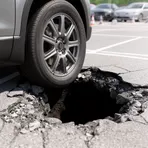
The Department of Public Works is finally restoring traffic signals at major intersections and fixing potholes on cratered streets that had begun to resemble the Ho Chi Minh Trail.
Academic text (2007) -
The stock market cratered after the unexpected bad news about the economy.
Synonyms
 6
6.4
6
6.4
To make an opening in something by cutting or piercing
Antonyms

Compounds
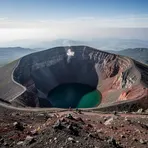
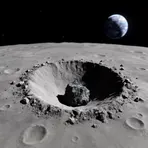




A national park in Oregon with the deepest lake in the United States formed in a volcano crater
How Deep

Surface Forms
Etymology
To crater as a verb comes from the same Greek krater 'mixing bowl', and it means to make a bowl-shaped hole in something, often after a blast or a meteor hit.