
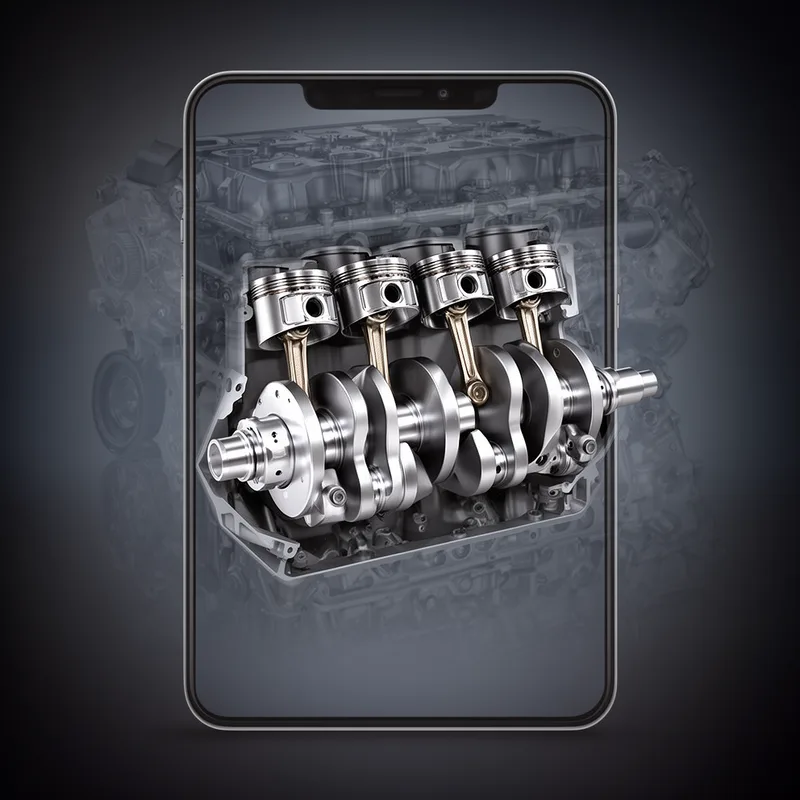
crankshaft
 3
6.8
3
6.8

- noun
- /ˈkræŋkʃæft/
- Specialized
- The kinematic engine uses the expansion and compression of the gas to drive pistons, and the power is removed through a conventional crankshaft.
Loading YouTube…
Watch on YouTubeThe crankshaft rotates, the crankshaft goes to the transmission.
- The crankshaft rotates, the crankshaft goes to the transmission.
Examples
-
Your starter engages your flywheel, your flywheel turns your crankshaft, and your crankshaft starts your engine.
-
Automotive IC engines typically convert no more than 25% of the energy content of fuel into crankshaft power, and usually considerably less.
Blog text (29) -
It's gonna be expensive to replace the crankshaft.
-
The crankshaft rotates, the crankshaft goes to the transmission.
-
If the students create precise drawings, they will be able to determine stroke length and the distance between the cylinder and the crankshaft.
Academic text (2007) -
With this data, they can determine the theoretical force on the piston and the torque on the crankshaft.
Academic text (2007) -
They contain all of the major parts (crankshaft, piston, cam, valves, etc.), and the operations can be clearly seen.
Academic text (2007) -
It clearly demonstrates the reciprocating action of the piston and the rotary movement of the crankshaft and flywheels.
Academic text (2007) -
Harralson used finite element analysis software from Algor Inc. of Pittsburgh to analyze several motorcycle components while they were being designed, including the engine crankshaft, frame, rear suspension, and wheels.
Academic text (2007) -
Replacing the crankshaft is crucial for the engine to work properly.
Surface Forms
Morphology
Etymology
Crankshaft comes from two simple words: crank, from an old word meaning 'bent' and later used for a bent handle you turn, and shaft, meaning a 'long pole'. So a crankshaft is a long pole with bends that turns to change up-and-down movement into turning movement inside an engine.