
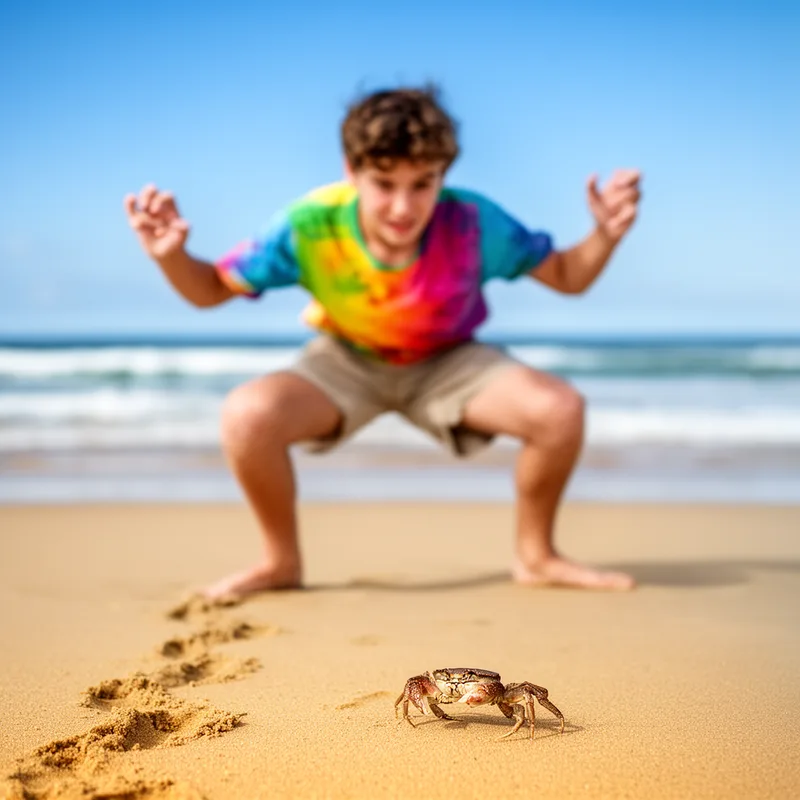
crablike


 1
4.2
- adjective
- /ˈkræbˌlaɪk/
- The monster was the size of an ox, and it scuttled about with a speedy, crablike gait.
- moving in a crablike way
Examples
-
Many games can be played (or many frameworks, or sets of two points/dots/extremes, can be created or used) by making crablike or sideways moves.
Academic text (2001) -
The game ends when it has reached the time/space sequence (n), which constitutes the last crablike or sideways move.
Academic text (2001) -
Castel, crablike against a wall, bloody.
Fiction book (2002) -
Not quite crablike, not quite urchinlike, not quite organic in appearance.
Fiction book (1999) -
He lay still, listening to the approaching crunching sounds as she moved awkwardly, crablike, toward him on her skis.
Fiction book (1996) -
She found but one fierce little crablike thing no bigger than a pinhead living solitary inside the dried blossom.
Fiction book (1997) -
The one exception to the crablike clustering of plantations around the coast was the Amazon's most important export crop prior to rubber, cacao.
Academic text (2001) -
There were two orange all-terrain vehicles parked out front, along with something that looked like a main battle tank, except that it had big crablike arms instead of energy cannons and slug throwers.
Fiction book (1991) -
Nor is it a wonder that in "Exchange Value," Cooter and Loftis regard their "queer, crablike" neighbor Miss Bailey as "a squirrely old broad" (32).
Academic text (2016) -
The monster was the size of an ox, and it scuttled about with a speedy, crablike gait.
Synonyms
 1
8.2
To move sideways or at an angle
Antonyms

Surface Forms
Morphology
Etymology
Crablike is made of crab and -like, where crab is the animal known for walking 'sideways' and -like means 'similar to'. So crablike describes something that moves or looks like a crab, especially by moving 'sideways'.