
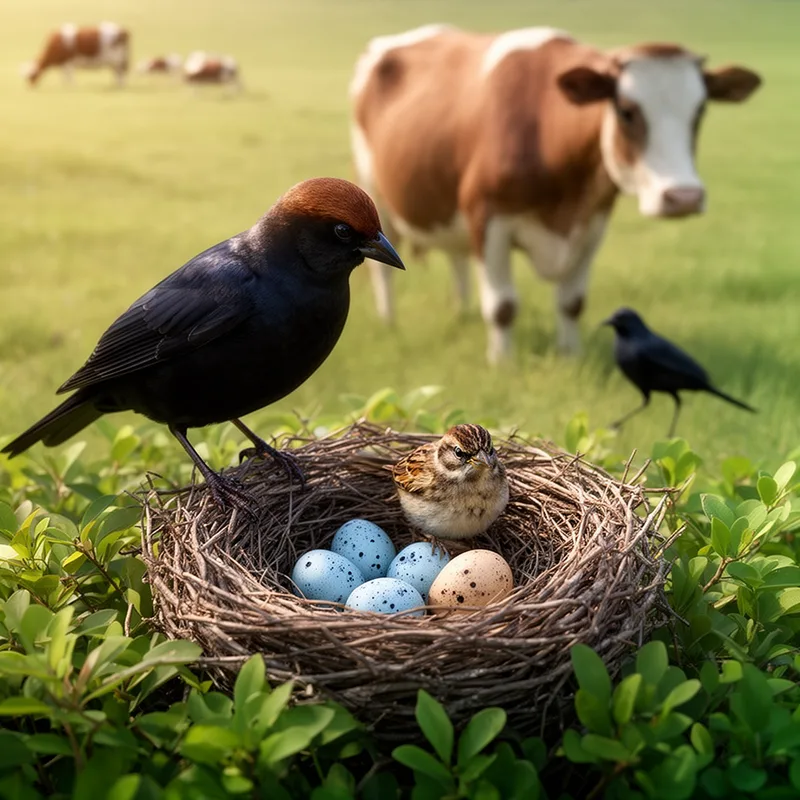
cowbird


 1
7.9
- noun
- /ˈkaʊˌbɜrd/
- US
- From 1972 to 2009, annual cowbird control near Kirtland's warbler breeding sites removed on average 3,897 cowbirds (USFWS 2009).
- cowbird control
- brown-headed cowbird
Examples
-
Yellow warbler, a species that produces helpless young, is primed to respond when a cowbird egg laid in its nest hatches a big, begging chick.
Academic text (2009) -
With continuing cowbird control, warbler populations are now producing surplus individuals in managed areas (Bocetti 1994).
Academic text (2012) -
A cowbird landed on the birdfeeder outside the kitchen.
Fiction book (2000) -
The Audubon Society has provided volunteers to conduct tours and assist with cowbird control.
Academic text (2012) -
Eastern phoebes will accept a brown headed cowbird speckled egg into their nest, though theirs are pure white.
-
North America has only two species of breeding birds (our brown-headed and bronzed cowbirds) that regularly lay their eggs in other species' nests.
Academic text (1990) -
The recovery strategies included the control of brown-headed cowbird populations, habitat management, annual monitoring of the population, research, and public education (Byelich et al. 1976, Kepler et al. 1996).
Academic text (2012) -
The cowbird lays its eggs in the nests of smaller birds, often at the expense of the host's own offspring.
-
When the cowbird chick hatches, it can push out the host's eggs to receive full nourishment.
-
Farmers often see cowbirds following cattle in fields, looking for insects disturbed by the grazing animals.
Surface Forms
Morphology
Etymology
The word cowbird is simply cow + bird, literally 'cow' and 'bird'. These blackbirds follow cows to find food and often lay their eggs in other birds' nests, so the name helps you remember both their habit of being near cows and their nesting trick.