

coup d'etat
- noun
- /kuː deɪˈtɑː/
- Literature
- The military executed a coup d'etat and overthrew the democratic government.
Loading YouTube…
Watch on YouTubeHe's a malicious coup d'etat destroyer of democracy.
- He's a malicious coup d'etat destroyer of democracy.
- So they're all of their intention was to change a country that was being, that was, that had stemmed out of a coup d'etat and it was a totalitarian regime.
- At the problem was that in the Medan coup d'etat, the government that came into power was no longer neutral.
Examples
-
After months of political unrest, the opposition launched a coup d'etat to seize power.
-
The sudden coup d'etat left the country in chaos and uncertainty.
-
It's a coup d'etat and it starts with the assassination of the Vice President.
-
But murderers get away with murder after a successful coup d'etat.
-
It was a coup d'etat.
-
There's been a coup d'etat.
-
At first, I thought it was just another a coup d'etat by just another warlord.
-
In Rome, rightists even considered a coup d'etat, so there were no good options for the Italian government.
-
The Maidan massacre was key in a plan of an ongoing coup d'etat and killings were planned in advance.
Synonyms

 622
8.1
622
8.1

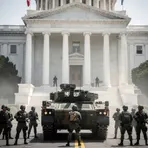
A sudden illegal act by a small group to take control of a government
 84
5.4
84
5.4
A sudden illegal action to seize control of a country's government by force
 29
6.1
29
6.1
The removal of a leader or government from power, often by force
 3
9.9
3
9.9
A sudden illegal attempt to take over a government by force

A sudden illegal change of government by a small group, often the military
Antonyms


Surface Forms
Morphology
coup + d'etat
The phrase is compositionally analyzable as coup (overthrow/blow) + d'état (of the state), so a learner who knows both constituents can derive the basic meaning 'overthrow of the state'. However, because d'état is a French element and the phrase is a lexicalized borrowing whose nuance (illegal/forceful change of government) may not be fully obvious to B1 learners, it is not fully transparent.
Etymology
The phrase coup d'etat comes from French: the word coup means 'a sudden blow' and d'etat means 'of the state'. So the image is a quick strike against the state, and that's why it now means 'a sudden illegal change of government'.