

cosmopolitanism
- noun
- /ˌkɒzməˈpɒlɪtənɪzəm/
- Specialized
- This is part of Stoic cosmopolitanism and Kai and Leo are extending this as well to the world of animals, plants, the environment.
Examples
-
The cosmopolitanism of this region allows for a mixture of cultures, languages, and traditions.
-
Her cosmopolitanism was reflected in her ability to easily interact with people from all walks of life.
-
The city's cosmopolitanism is evident in its diverse population, with residents from many different countries.
Synonyms

An open attitude to people and ideas from many countries
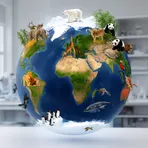
Where animals live in different parts of the world
Antonyms



How Widespread
 6
8.7
6
8.7

- Specialized
4
2.9
- Specialized

 1
9.9
∞
1.0
1
9.9
∞
1.0
Surface Forms
Morphology
cosmopolitanism = cosmopolitan (semi-transparent) = cosmopolitan + ism
Structurally transparent (adj. + '-ism') but the application to species/population distribution is a domain-specific extension that may not be obvious to all learners.
Etymology
Cosmopolitanism comes from Greek cosmo- ('world') and polites ('citizen'), so it can be thought of as 'world citizenship'. In science this idea becomes a simple fact: a species' cosmopolitanism means it is 'found all over the world' across many regions.