

cosmic ray
 15
6.7
15
6.7

- noun
- /ˈkɒzmɪk reɪ/
- Specialized
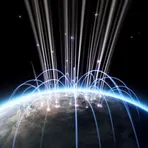
- When cosmic rays enter the Earth's atmosphere, they collide with air molecules to create secondary particles.
- cosmic ray sources
- cosmic ray energy
- cosmic ray interactions
Loading YouTube…
Watch on YouTubeWe are as you know, the Earth is continuously hit by flux of cosmic rays.
- We are as you know, the Earth is continuously hit by flux of cosmic rays.
- But then the real issue that is often underplayed is the risk to the human body from cosmic rays.
- So we have things called cosmic rays out in space and they strike the atmosphere and hit the particles, the gas particles.
- But it turns out cosmic rays were probably not the culprit.
- But these cosmic rays coming in very fast, OK, cosmic rays coming very fast.
- We've learned a lot about cosmic rays, but we haven't detected dark matter.
- Nobody has ever seen an antinucleus come in in in cosmic rays.
- So when those cosmic ray volleys come in, they can't pass through the core.
- So just living life, you know, being hit by cosmic rays, by chemicals in the environment, by secondhand smoke, whatever it might be.
Examples
-
On a larger scale, cosmic rays can be accelerated by moving magnetic fields.
Academic text (1990) -
Will a less powerful solar wind result in higher cosmic ray concentrations hitting our atmosphere?
Blog text (28) -
All right, so this is another model of a cosmic ray shower.
-
This will show whether the materials have been exposed to cosmic rays.
-
We introduce all these to cosmic rays.
-
There is a possibility of cosmic rays coming from stars, and that could be dangerous to them.
-
The cosmic rays will travel from this generator to this chamber.
-
From studies of the 10 Be isotope, the cosmic ray lifetime also appears secure.
Academic text (1990) -
The differences arise because Earth's atmosphere protects us from these cosmic rays.
-
We've learned a lot about cosmic rays, but we haven't detected dark matter.
Synonyms
 2
6.6
2
6.6
High-energy rays from space that reach Earth
Surface Forms
Morphology
The components 'cosmic' (relating to the universe) and 'ray' (a beam) transparently suggest a beam or radiation coming from space, so a B1 learner who knows both words would likely infer a general ‘radiation from space’ meaning. However, the precise scientific sense (highly penetrating ionizing particles rather than a visible light ray) is specialized and not fully predictable from the constituents, so the expression is only partially transparent.
Etymology
Cosmic ray started as a simple image: cosmic meant 'from space' and ray meant 'a beam of energy or particles'. So, the phrase now names 'the powerful particles or radiation that come from space and hit the Earth's atmosphere'.