
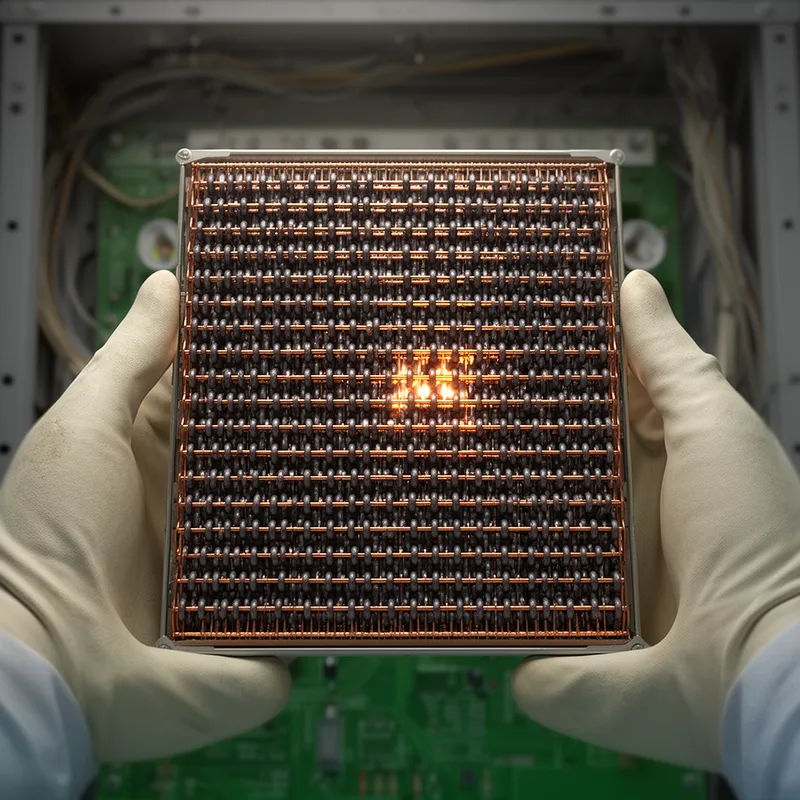
core memory
- noun
- /kɔr ˈmɛməri/
- Archaic
- Many engineers fondly remember core memory for its unique design of tiny magnetic rings used to retain information.
Examples
-
In early computing, core memory was essential for data storage before being replaced by modern semiconductor memory.
-
The old computer was equipped with core memory, allowing it to store small amounts of data using magnetic cores.
-
"The programs are hard-wired in core memory."
Fiction book (1996) -
It's the first core memory, one of the first random access core memories as I recollect.
-
It had 32,000 bytes of core memory.
Academic text (2001) -
And Forrester and one of his graduate students create the magnetic core memory that's part of this whirlwind system.
-
Their computer equipment was nearly as antiquated as the 36K of wire-wrapped core memory under the navigation console.
Fiction book (1996) -
The computer itself was the size of a big, wooden office desk, but it had only 8k of magnetic core memory coiled in little metal donuts.
Blog text (7)
Synonyms


 1
8.3
1
8.3
A group of tiny magnetic rings used in old computers to store data
Surface Forms
Morphology
The meaning 'a particularly important or central memory' is directly derivable from combining 'core' (central/essential) with 'memory' (a recollection). This is a straightforward compositional/metaphorical extension that a B1 learner who knows the basic senses of the constituents would readily infer, though learners who only know a very technical sense of 'core' (e.g., a ferrite ring) might be briefly puzzled.
Etymology
Core memory comes from early computers that used tiny magnetic rings called cores. Each ring could hold information even when the 'power' was off, so the picture of small rings holding data helps explain why the term means a strong, long-lasting kind of computer memory.