

conversion factor


 1
4.0
1
4.0
- noun
- /kənˈvɜrʒən ˈfæktər/
- Specialized
- And that's going to depend on the actual conversion factor that you prefer to use and you're used to if you use TDs and you don't use EC.
Loading YouTube…
Watch on YouTubeAnd here our Faraday's constant is our conversion factor.
- And here our Faraday's constant is our conversion factor.
- You'll multiply by that conversion factor to get radians.
- The conversion factor, The conversion factor?
Examples
-
You'll multiply by that conversion factor to get radians.
-
The comparisons performed in our study were based on the assumption that the conversion factor should be consistent over the range of concentrations.
Academic text (2008) -
So what conversion factor or what efficiency did you assume?
-
C square is simply the square of the speed of light, and that's the conversion factor between energy and mass.
-
There's a reason BP has a 3:1 conversion factor in their energy review.
Blog text (32) -
This conversion factor, an average used by the EPA for the nation as a whole, takes into account the energy used in the generation and delivery of energy to end users.
Academic text (2001) -
Whole weights were estimated from the reported dressed weights by multiplying by a conversion factor of 1.33 (Miyake, 1990).
Academic text (1996) -
New, more accurate measurements of several constants promise to refine even further the recommended values for the basic constants and conversion factors of physics and chemistry produced by 1986's least-squares adjustment.
Academic text (1993) -
To convert inches to centimeters, you multiply by the conversion factor of 2.54.
-
In chemistry, the conversion factor between moles and grams is essential for accurate calculations.
Synonyms
 77
2.8
77
2.8
A number that divides another number exactly
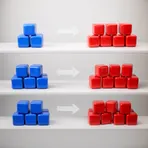
A number you multiply one amount by to get another amount that changes the same way

A number that makes an object bigger or smaller by the same amount

A number that tells how many times to use a value to get a result

A number that multiplies a variable in math or science
Surface Forms
Morphology
The phrase is compositionally transparent: 'conversion' specifies the kind of 'factor', and 'factor' denotes a number used to multiply — together they directly denote a number/ratio used to convert units. This is a common, cross-linguistically similar technical composition (e.g. Spanish 'factor de conversión'), so a B1 learner who knows both words should infer the meaning.
Etymology
Conversion factor is a compound of conversion (to change) and factor (a number that multiplies). Imagine a small 'multiplier' or key that you use to turn inches into centimetres — that's why it means 'a number used to change a measurement from one unit to another'.