

to conjure up
 40
6.2
40
6.2

- phrasal verb
- /ˈkɒndʒər ʌp/
- Jim went off by himself often, and we worried, conjuring up all kinds of possible catastrophes.
- conjure up images
- conjure up pictures
- conjure up memories
Loading YouTube…
Watch on YouTubeIn your mind's eye, conjure up the image of a good sprinter.
- In your mind's eye, conjure up the image of a good sprinter.
- The fear that is being conjured up is the fear of what is different.
- Why are we conjuring up things to worry about?
- There's some sense in which our conception of God, though, is conjured up by our own mind.
- I'm just saying I love the phrase willpower, but willpower isn't something you conjure up.
- Now I know they're cliches, but to some people that's the sort of image that they might conjure up.
- And so I like this phrase, realistic utopianism in that it conjures up the idea of trying to get to a better place.
- They stay in touch with their members and they do it in a way that conjures up fear, anxiety and threat.
- She thinks that like, watching these movies, she's not a big fan of scary movies, that watching these movies conjure up these bad spirits.
- And almost as bad as the fires themselves is the anti fire hysteria that has been conjured up in the minds of the woke left cancel mob.
- He's here as a guarantee of what's going to happen next, that the decadence that Couture was conjuring up will indeed be horribly punished.
Examples
-
The old are pessimists because they cannot conjure up the energy for optimism.
Academic text (2011) -
You sit up there by yourself and conjure up the worst possible scenarios.
Fiction book (1992) -
The fear that is being conjured up is the fear of what is different.
-
Why are we conjuring up things to worry about?
-
Oh, just a little something I conjured up.
-
In that one word, his voice conjures up for me 200 years of humanity and history.
Fiction book (1997) -
In your mind's eye, conjure up the image of a good sprinter.
-
The phrase "collective security" conjures up NATO and its importance for peace and prosperity across Europe.
Academic text (2011) -
For some people, the eschaton conjures up medieval images of judgment and condemnation.
Academic text (2015) -
When she closed her eyes, she could easily conjure up memories of her childhood adventures.
Synonyms
 126
7.9
126
7.9
To make something appear as if by magic
 68
9.1
68
9.1
To cause a spirit or dead person to come, often by magic
 38
3.9
38
3.9
To think of a new or unusual idea
 23
7.7
23
7.7
Ask a spirit or god for help, often using a ritual
 16
4.1
16
4.1
To produce or show something new for others to use
 11
3.2
11
3.2
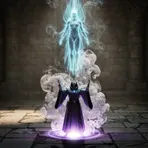
To make a memory or image appear in your mind
 7
5.7
7
5.7
Cause a spirit or magic thing to appear
 7
4.9
7
4.9
Cause a feeling or reaction to appear in people
 6
6.0
6
6.0
To call up a spirit or make something appear as if by magic
 3
5.5
3
5.5
Make something appear, disappear, or change as if by using a special power
 2
5.3
2
5.3
Make something start or appear, often like magic


 1
7.0
1
7.0
To make something quickly from very little when needed

Ask a spirit or magic power to come and act
How Vivid

Surface Forms
Morphology
The meaning 'to bring into existence or to mind' is directly derivable from 'conjure' (to produce or summon, often magically) plus the particle 'up' which signals completion or intensification; together they convey producing or evoking something into awareness. This verb+particle composition follows familiar English patterns and is likely understandable to a B1 learner who knows both constituents.
Etymology
Conjure up comes from magic shows. A magician would conjure something up and make it appear from nowhere, so the phrase now means 'bring to mind' or 'create' as if by magic.