
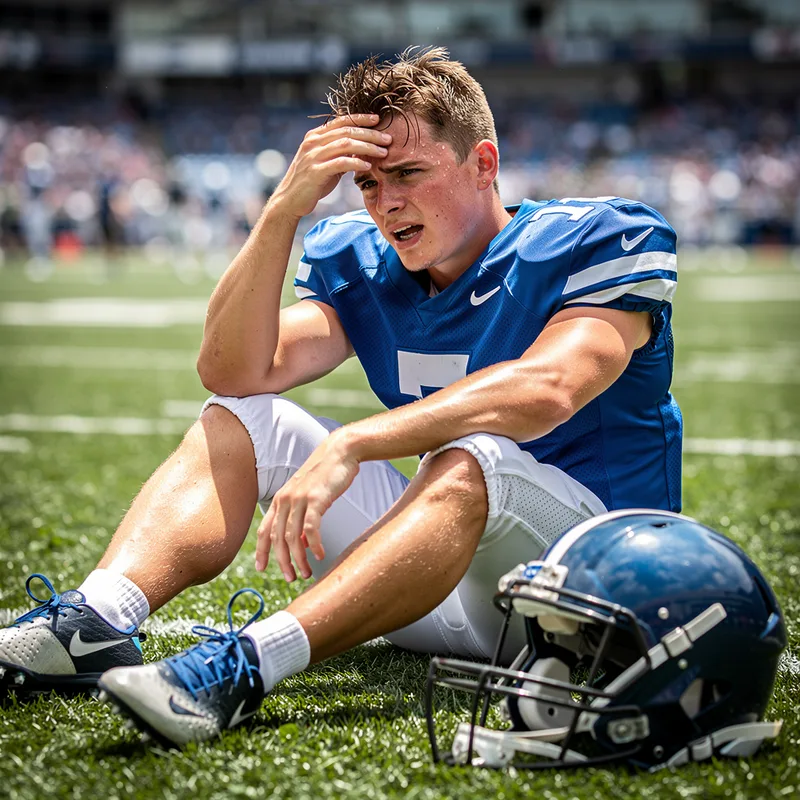
concussion
 144
5.3
144
5.3

- noun
- /kənˈkʌʃən/
- There's no fracture, but Captain Danko does have a concussion.
- sports-related concussions
- suffer a concussion
- even a mild concussion
Loading YouTube…
Watch on YouTubeIt's easier actually to give you a concussion when you're sparring.
- It's easier actually to give you a concussion when you're sparring.
- Have you ever had a concussion playing sports, a car accident?
- When I broke my neck and, and, and was struggling with a concussion, getting out of bed was difficult.
- Also the concussions, concussions breed a higher tendency to have more concussions.
- And it's actually a way to diagnose and follow recovery from concussion.
- Maybe you could list off a few more, but how common is TBI and concussion?
- It can actually help being neuroprotective against against concussions.
- So if we look at soccer, the the biggest concussion risk in soccer is actually in the act of heading.
- I don't have TBI but I have had a few concussions before, but right now I feel fine.
- It was almost seen as a sign of weakness to come off the field with concussion, whereas now is like, what are you doing?
- I think I've only shared, I've shared the fact that like Christy has, she suffers from post concussion syndrome.
- And then there was four of us that sort of like a bit wobbly on our feet, probably concussion, like a mild traumatic brain injury.
- But when I came back to consciousness, a trainer took me to the sine lines and checked me for a concussion and told me I was fine and could go back in.
- And so then I started to be that that hits that were less and less significant were starting to give me concussions.
Examples
-
The bad news, he has a concussion and a slipped disk.
-
Have you ever had a concussion playing sports, a car accident?
-
Yeah, I think I got a concussion.
-
I might have a concussion.
-
A young man comes in with a cerebral concussion.
-
He just has a mild concussion, it's nothing serious.
-
The ambulance attendant suspected a concussion and wanted to bring her to the hospital immediately, but she refused.
Fiction book (2001) -
An examination of his brain linked his depression to brain damage caused by repeated concussions sustained during his career.
Academic text (2011) -
After the fall, she was taken to the hospital to get evaluated for a concussion.
-
The athlete received medical attention because he was experiencing symptoms of a concussion.
How Serious
- Specialized

- Specialized
75
3.7
144
5.3
32
1.0
91
1.4
Surface Forms
Morphology
Etymology
Concussion comes from the Latin word concutere, which means 'to shake violently', so a medical concussion is literally the brain being shaken by a blow and that is why it can cause confusion or a brief loss of consciousness.