
compression ratio


 1
6.0
1
6.0
- noun
- Specialized
- In most cases, the larger history enables a higher compression ratio.
- high compression ratios
- increase the compression ratio
- compression ratio obtained
Examples
-
As segment sizes increase, the compression ratio approaches the continuous-stream compression ratio much earlier than independent segments do.
Academic text (1998) -
The input level, the output level, and the compression ratio are indicated for each of the segments.
Academic text (1990) -
All of the test images maintained a higher compression ratio than the random images.
Academic text (1998) -
All of the test images performed better than the random images in both data rate and compression ratio, as shown in the graph.
Academic text (1998) -
In practice, it's limited to a lower compression ratio; otherwise, you get spontaneous ignition.
Blog text (2) -
A high average compression ratio, as well as good worst-case compression behavior, is therefore essential.
Academic text (1998) -
For audio, bit depth, sample rate, compression ratio, and codec are the major factors.
Blog text (11) -
The rate of compressed data is related to the throughput by the compression ratio.
Academic text (1998) -
Experimentation has shown a relationship between the amount of renormalization and the compression ratio from which a correspondence can be drawn.
Academic text (1998) -
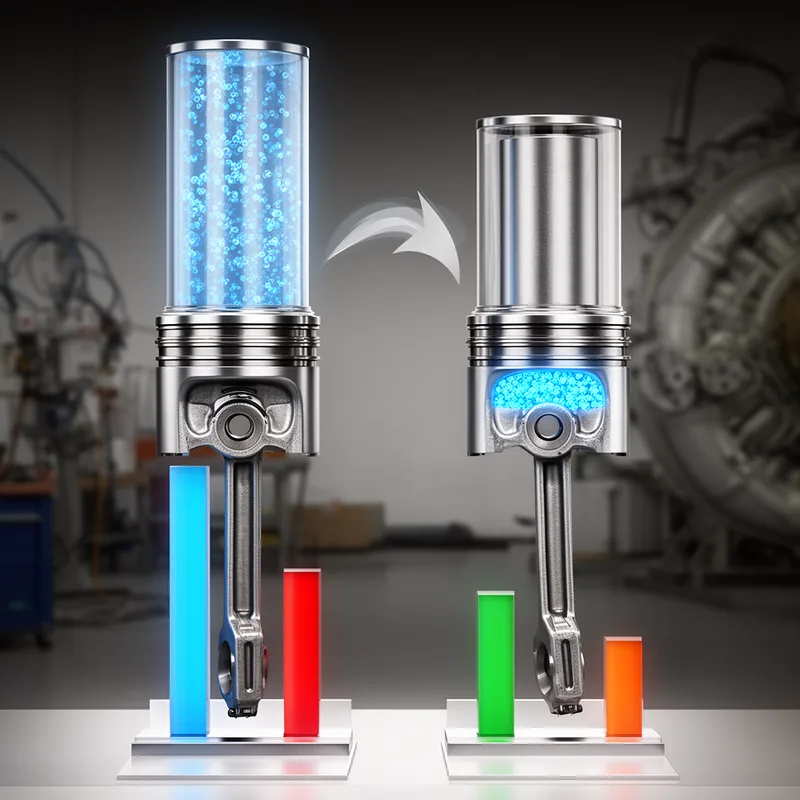
In automotive engineering, a higher compression ratio can improve fuel efficiency and power output.
Surface Forms
Morphology
The noun phrase is transparently compositional: 'compression' (applying pressure/decreasing volume) combined with 'ratio' (a numeric relation) directly yields a numeric measure describing the degree or amount of compression. Although the precise technical formulation (specific pressures in an engine or compressor) is domain-specific, the core meaning is clearly derivable from the parts and matches analogous constructions in other languages.
Etymology
The term compression ratio comes from the simple idea of compression (the 'squeezing' of a gas) and ratio (a 'comparison'). It measures how much the gas is squashed by comparing the pressure at the end with the pressure at the start, so a higher compression ratio means the gas is squeezed more and the engine can make more power or use fuel more efficiently.